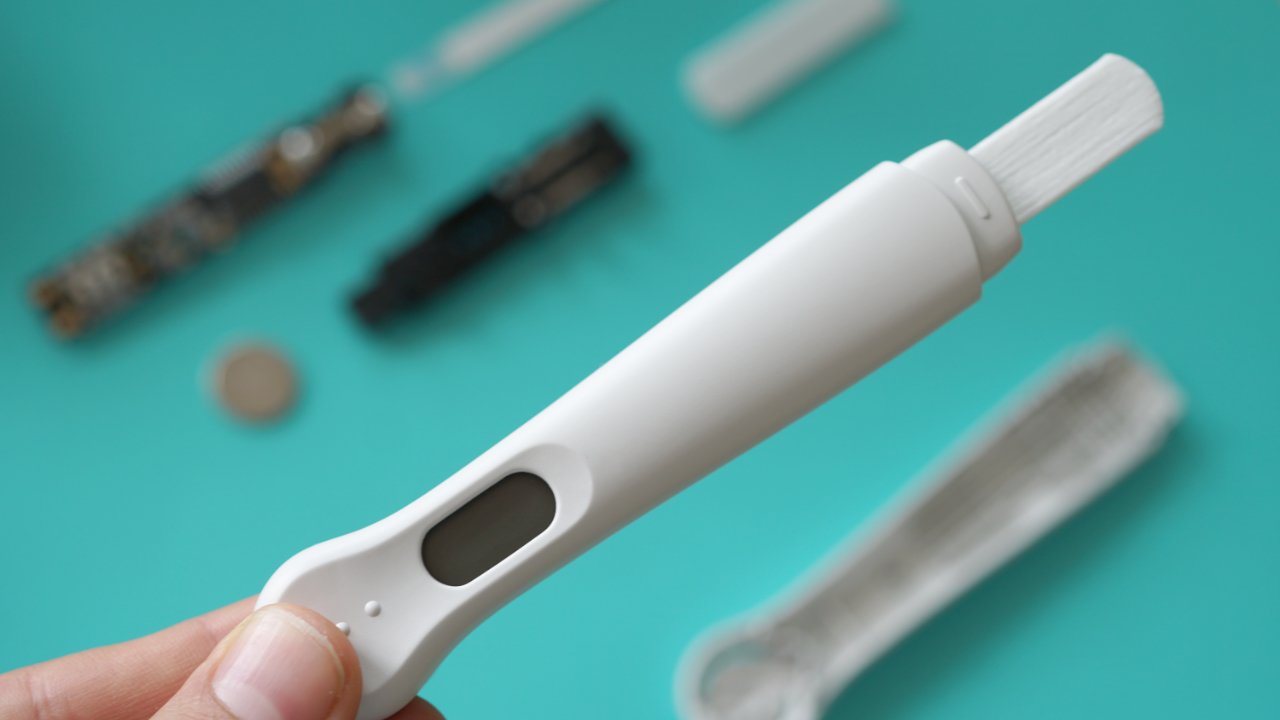
A teardown of a digital pregnancy test has created a buzz after revealing it contained a standard paper test, similar to those used by GPs.
The experiment has raised questions about whether the extra cost of digital pregnancy tests is justified.
Some say the electronics give women a clearer answer but others point to the e-waste created by digital test kits.
The experiment also found the digital test contained a microprocessor more powerful than early home computers.
But the electronics themselves did not play a role in the hormone detection.
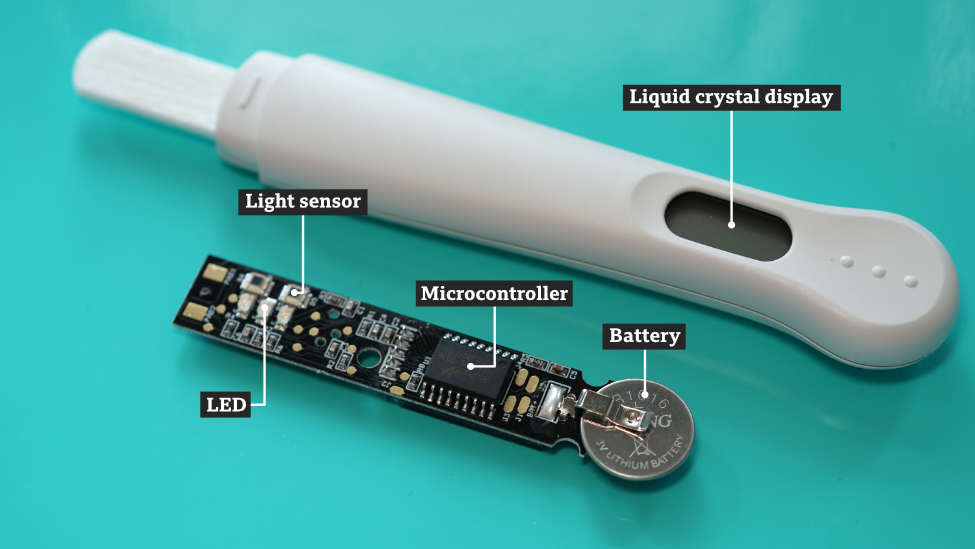
image captionThe electronics inside a digital pregnancy test do not analyse urine
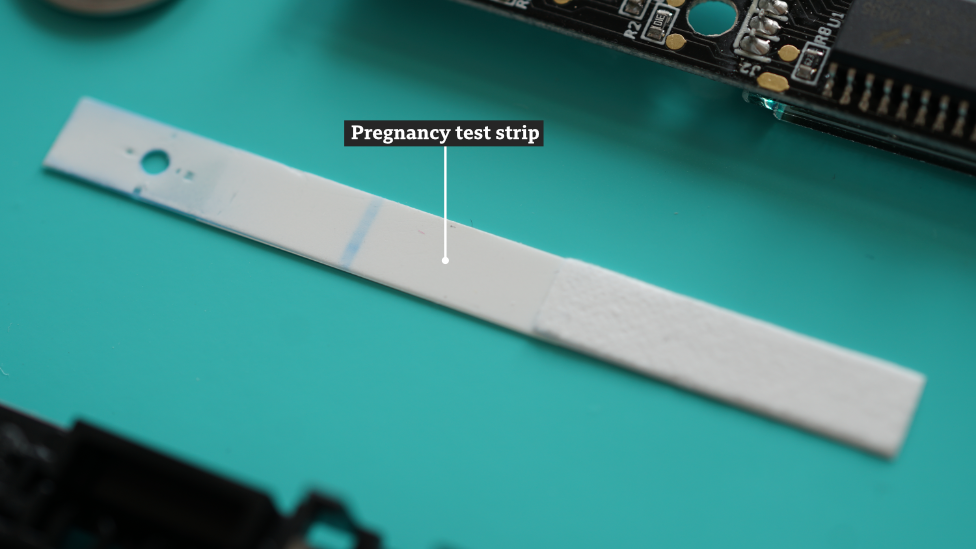
image captionThe actual testing is done on a standard paper strip inside the digital stick
image captionLEDs light up the strip and two light sensors detect whether the test has reacted
image captionThe result is then displayed in words on the screen
Hardware researcher Foone decided to find out what was inside a pregnancy test in response to a tweet from a man questioning whether the digital pregnancy test his wife had bought was worth the extra money.
Digital pregnancy tests that display the words “pregnant” or “not pregnant” on a screen often cost about four times as much as ones that simply provide a single or double line on a paper strip to indicate pregnancy.
For the experiment, Foone used a Walmart Equate digital pregnancy test. The inner workings are similar to those in other brands including Procter and Gamble’s Clear Blue and the Boots own-brand digital pregnancy test.
Foone was surprised to find the testing element inside was basically a standard paper test.
Paper test strips detect a hormone called human chorionic gonadotrophic, which is produced during pregnancy. The test strip is treated with a chemical that changes colour when the hormone is present.
The electronics simply read the result from the paper test and then displayed the “pregnant” or “not pregnant” read-out.
The circuit board featured a “surprisingly complicated chip”, more powerful than the CPU used in the original IBM PC.
Foone concluded that digital tests were “probably not worth the money”, given that paper strip tests can cost as little as 20 cents (15p).
“It’s a scam, basically,” they wrote on Twitter. “Computers are cheap now. People are buying the digital one thinking it’s the more accurate fancy model, but it is the same.”
However, others pointed out that paper tests could be misread and judging the result of the test was subjective.
“It is not stupid or wasteful to use a hardware interface to help women with this,” said tech YouTuber Naomi Wu.
Assistant professor of bio-nanotechnology Vittorio Saggiomo agreed that interpreting the lines on a paper test could vary from person to person.
“I can see a faint line, another person doesn’t see anything,” he said.
Another user added: “The information you are supposed to get out of it is literally life-altering. You don’t want to guess the outcome, or have to re-read the manual 10 times to know how to interpret a faint line. I’d happily pay a few euros more.”
Kate Bevan, a tech editor at consumer watchdog Which?, described it as a fascinating experiment but questioned whether the digital tests were creating unnecessary e-waste.
Taking pregnancy tests apart appears to be a fairly frequent phenomenon on Twitter.
image captionThe tablet inside a pregnancy test absorbs moisture and is toxic to eat
Also contained within the test is a moisture-absorbing tablet, to keep the circuitry dry before it is used.
It has been incorrectly suggested on social media that this is an emergency contraceptive pill hidden inside the test.
One video suggesting this has been viewed 4.5 million times on Twitter.
In fact, the moisture-absorbing tablet is toxic and should not be eaten.
Image caption
Zack Smith has created a platform for jobs in the gig economy
“I think a lot of folks like myself never even get a chance, because folks don’t answer their phones, or listen to their idea, but put them in a box they shouldn’t be in,” says Zack Smith, the founder of Boston-based Jobble.
He’s talking about how hard it can be for black tech entrepreneurs to raise money.
But Mr Smith saw it as a challenge.
“It doesn’t matter what box they put me in to begin with, I’ll get out of that box and prove to them I’m bigger and better. I think this fuels me,” he says.
His firm is a US platform for jobs in the gig economy, offering work to those who want flexible hours.
According to a study of 9,874 US business founders by California-based social enterprise RateMyInvestor, only 1% of start-ups receiving venture capital were black.
But Mr Smith was fortunate to have New York-based Harlem Capital Partners, which focuses its investments on minority and women founders.
“They’ve been extremely supportive, as an investor and also a friend and a partner,” he says
Black Lives Matter not only shone a spotlight on policing, but also on other fields, like the technology industry.
In the US, 13% of the workforce is black, but at Google that proportion is just 3.7% and at Facebook 3.8%.
Image copyright Phillip Faraone/Getty Images
Image caption
Marlon Nichols says most funding goes to all-white teams
To understand why this is, follow the money, says Sydney Sykes, a Harvard graduate and venture capital investor who in 2018 co-founded BLCK VC.
Venture capital – that is, early investments in a company of between $1m (£750,000) and $30m in return for shares – is how most new start-ups get out of the blocks.
But 81% of venture capital (VC) funds specialising in making these types of investment lack a black partner.
Partly as a result, 75% of fundraising rounds go to all-white founding teams, says Marlon Nichols, a founding managing partner at California’s MaC Venture Capital.
‘Exciting investments’
Sydney Sykes says investors in tech start-ups “go by their gut feeling, and that’s where bias creeps in”.
She says investors financially back someone if they are “connected with this person”, or perhaps an entrepreneur reminds them of Elon Musk or Mark Zuckerberg.
Image copyright Sydney Sykes
Image caption
Sydney Sykes has started a network of black investors
But she believes “when you close your mind to different types of entrepreneurs, you’re missing out on exciting investments and great companies”.
And Marlon Nichols asserts that ethnically diverse founding teams deliver investors better returns – on average 3.3 times their invested capital, compared with 2 times for all-white founders.
Ms Sykes started a network of black investors.
She and another VC principal, Frederik Groce, held a dinner and invited all the black people they knew in VC in the San Francisco Bay area, as well as other friends.
Image copyright Benedicta Banga
Image caption
Benedicta Banga says funding can be an issue
“We ended up being about 30 people, and most of the black investors in California, which is pretty wild,” she says.
Dinner went on “very much longer than it was supposed to” and by the end they’d started a network to encourage and mentor black people wanting to enter venture capital.
Duplicating excesses?
Black business founder Donnel Baird says raising funding has been “far and away the hardest part”.
Mr Baird’s start-up, Brooklyn-based BlocPower, hires local unemployed workers to replace apartment blocks’ antiquated climate systems with modern heat pumps.
These are 20-50% more efficient than air conditioners and two to three times more efficient than boiler-based furnace systems, he says.
The biggest challenge is documenting each building well enough to attract crowdsourced finance, so systems won’t cost residents anything up front, and can be paid for out of future savings.
Image copyright Roy Rochlin/Getty Images
Image caption
Donnel Baird says Silicon Valley is set for a change
They’ve developed a modelling tool called BlocMaps that quickly integrates city data sources with on-site observations, while drawing on the 1,000 buildings they’ve worked on so far in New York.
He says as founders like him make profitable exits, and have access to capital to invest in new start-ups, Silicon Valley will change.
“I don’t think it’s going to be a very long time from now,” says Mr Baird. “I think it’s going to be five years.”
But he asks of his generation of black founders: “Are we going to try to help Silicon Valley build the better world it says it wants to build, or are we going to duplicate the same excesses just with a black person in charge?”
Growth circles
Turning to the UK, lack of funding has also been an issue, one which the Black Lives Matter (BLM) movement has helped highlight.
In the wake of BLM, many British people, both black and white, want to support black-owned small businesses, says Benedicta Banga, who was born in Zimbabwe and lives in Solihull in the West Midlands.
So she started Blaqbase, a marketplace platform, largely because she wasn’t finding things she needed locally “like makeup for my skin type, and black-owned brands weren’t very visible online”.
Image copyright Blaqbase
Image caption
Blaqbase has gained users in the UK, US, Asia and the Caribbean
Black-owned businesses are the least-funded businesses, she says, and this is problem is compounded if you aren’t visible.
“Then you don’t grow, and you don’t get funded because you’re not growing,” she says.
While she initially thought of the platform as just being UK-based, most of the businesses on it ship worldwide, and her platform has gained users in the US, Asia and the Caribbean, she says.
‘Beacon of hope’
Another British-based tech entrepreneur, Ikenna Ordor, has started a sharing economy platform for higher-end vehicles – Starr Luxury Cars – which has expanded into private jets.
A few of his car clients turned out to be private jet owners, who were keen to earn money from renting their aircraft out.
Image copyright Ikenna Ordor
Image caption
Ikenna Ordor has found his services in demand
When coronavirus struck, these services were suddenly in demand. City workers who would always take the train into London, started to rent cars twice a week to drive to the office, says Mr Ordor.
As a Nigerian-born male, he says there is a stigma associating Nigerians with fraud. He also says black-owned businesses are less likely to be offered bank loans than other companies.
So he ultimately hopes that his example can be a “beacon of hope for young men thinking about starting businesses”.
While such a move would increase workers’ take-home pay now, there’s a catch. And employeeswho understand thatmay not be so eager for the bigger paychecks.
Just last Friday, the Treasury issued guidance for an executive order issued by President Trump giving employers the option to temporarily defer their workers’ payments of Social Security taxes — which amount to 6.2% of their wages. The deferral option is in effect for any paycheck issued from September 1 through the end of this year. Only employees whose regular pre-tax income is less than $2,000 a week (or less than $4,000 every two weeks) would be eligible.
In theory, the move is meant to help boost the economy because deferring Social Security taxes would put more money in workers’ pockets this year. Someone making $50,000, for instance, would see an extra $119 in her paycheck every two weeks until December 31.
But the catch is you’d have to pay those deferred taxes back between January 1 and May 1 of next year, said Mark Luscombe, principal analyst for Wolters Kluwer Tax & Accounting. So that same $50,000 earner would have to pay not only her regular Social Security taxes on her earnings for the first four months of 2021, she’d also have to pay the extra $119 per paycheck that her employer deferred this year.
Employers don’t want to leave workers on the hook for that, said Neil Bradley, chief policy officer for the US Chamber of Commerce. “You’re going to have to double their taxes beginning in January. You’re making a decision about people’s ability to make ends meet next year.”
What’s more, employers would be responsible for paying the deferred taxes back if the employee doesn’t. That will be an issue if an employee or seasonal worker leaves a company by early next year. Employers either will have to scramble to withhold much of that person’s last paycheck or foot the bill themselves. And irony alert: If a company does foot the bill, that could be considered taxable compensation to the ex-employee and subject to both income and payroll taxes, Luscombe said.
Should an employer want to implement the deferral, it will take a few weeks to adjust their payroll systems. Employers that administer their own systems have a lot of work ahead of them. Those that use big payroll providers, like ADP, won’t have to do the technical heavy lifting, but they will need to clearly communicate what’s happening to their employees.
Companies are not required to give employees a choice in the matter.
“It’s a business decision,” said Pete Isberg, ADP’s vice president of government affairs. But ADP is changing its systems so clients may choose to give workers the chance to elect deferral if they wish.
It’s still too early to tell how many private sector employers will choose to implement the payroll tax deferral. But based on feedback they’ve gotten so far, both Bradley and Isberg don’t expect many will. “The best feedback we’re getting is ‘We’re still looking at it,'” Bradley said.
And based on what ADP has heard anecdotally, Isberg said, “Most employers are leaning toward not adopting this program.”
Tuesday, Graceland, the estate turned memorial for musical pioneer Elvis Presley, was found to be vandalized with spray paint.
According to local outlet Commercial Appeal, the wall and sidewalk surrounding the Memphis landmark and tourist attraction were found to have graffiti sprayed all around them on Tuesday morning. Protest slogans like “Defund the Police”, “Abolish ICE”, “Black Lives Matter” and more were found in black and orange letters around the property.
Similar graffiti was found on the historic concert venue The Levitt Shell. People wrote “Eat the Rich” as well as phrases like “F**k Trump” and “Defund MPD [Memphis Police Department.]”
People sharing photos of the spray-painted walls noted that Elvis fans from around the globe usually write their names and tributes to the King of Rock n’ Roll on the wall outside his home. Some people on Twitter called for the vandalism to stop, saying it was disrespectful to Presley’s legacy.
Despite many people angry at protesters spraying the walls with graffiti, some people commended the efforts, saying it was a good spot to draw attention to issues in the city. “Graceland is an expensive, for-profit institution that fleeces tourists while giving nothing back to the black communities it sits in the middle of. It is a symbol of everything this city gets wrong abt [sic] economic development and activists are smart to use it to promote their cause,” one person tweeted.
In a statement to Commercial Appeal, Natalie Wilson, an executive director of Levitt Shell, spoke about how disappointing it was to discover the graffiti. “We wake up, excited to celebrate our city on 901 Day, and we see our beautiful historic landmark defaced with messages of pain,” she said. “And that breaks our heart. We’re broken-hearted and devastated by this.”
President Emmanuel Macron toured neighborhoods where Lebanese officials have been personae non gratae, embraced activists who have called for the downfall of the Lebanese establishment and even had dinner with the singer Fairuz, the single most popular Lebanese cultural icon who has for decades shunned the country’s political leadership.
It was beginning to feel a lot like 1920.
Back then, General Henri Gouraud declared a new Lebanese state whose first Prime Minister would be Auguste Adib. Macron on Tuesday says he wants to usher in a new “political chapter” and has sponsored a political process that led to the naming of a new Prime Minister-designate named Mustapha Adib.
The two Adibs appear not to be related. Still, the optics have been dizzying. Even for a country notorious for being subject to heavy external interference, Macron’s tour of Lebanon has been extraordinary. In one fell swoop, he seemed to stand in for Lebanon’s despised leadership, and it has aroused mixed feelings.
During months of economic spiral that saw the local currency tank, poverty rates soar and the banking sector teeter on the verge of collapse, people in Lebanon decried the absence of leadership, accusing the political elite of plundering what little resources were left in the country.
An explosion that laid waste to large swathes of the capital on August 4 seemed to ring the death knell of the state.
Fearing the collapse of the tiny eastern Mediterranean country, the international community quickly stepped in. It was a stunning volte-face.
In recent months, world leaders repeatedly proclaimed Lebanon’s political system untouchable, refusing to deal with the corrupt leadership amidst the country’s economic downfall. This came after nearly a decade of the international community flushing Lebanese coffers with money in exchange for hosting the largest number of refugees per capita in the world.
Macron was in Beirut within days of the explosion, followed by the French minister of armed forces. US Undersecretary of State David Hale also paid a visit to Lebanon, coinciding with Iranian Foreign Minister Javad Zarif’s own tour of the country. High-level representatives from the UK, Turkey, and various EU countries also visited the damaged city.
Suddenly the Lebanese aren’t feeling abandoned, and Macron seems to be saying all the right things.
He’s supported Lebanese protesters’ demands for a nonsectarian, civil state, something that seems to be gaining traction among the country’s leadership. He’s called for a new “political pact” that could upend previous national agreements, namely the Taif Agreement which, in 1990, ended the country’s 15-year civil war but critics say created fertile ground for the corruption and mismanagement that would continue to fester for decades.
Still, one wonders, what’s in it for Macron? When Gouraud pronounced the birth of the Lebanese state, he ushered in a French mandate. In 2020, the Lebanese government currently in the works is already being dubbed the government of Residence des Pins — the home of the French ambassador in Beirut and the seat of power of the former mandate’s high commissioners.
What this means for the country’s political system is unclear. But the sense of dereliction has been replaced by unease. And increasingly, the future is beginning to look eerily similar to the past.
New research suggests that power companies are dragging their feet when it comes to embracing green energy sources such as wind and solar.
Only one in 10 energy suppliers globally has prioritised renewables over fossil fuels, the study finds.
Even those that are spending on greener energy are continuing to invest in carbon heavy coal and natural gas.
The lead researcher says the slow uptake undermines global efforts to tackle climate change.
In countries like the UK and across Europe, renewable energy has taken a significant share of the market, with 40% of Britain’s electricity coming from wind and solar last year.
Image copyright Getty Images
But while green energy has boomed around the world in recent years, many of the new wind and solar power installations have been built by independent producers.
Large scale utility companies, including many state and city owned enterprises, have been much slower to go green, according to this new study.
The research looked at more than 3,000 electricity companies worldwide and used machine learning techniques to analyse their activities over the past two decades.
The study found that only 10% of the companies had expanded their renewable-based power generation more quickly than their gas or coal fired capacity.
Of this small proportion that spent more on renewables, many continued to invest in fossil fuels, although at a lower rate.
The vast majority of companies, according to the author, have just sat on the fence.
“If you look at all utilities, and what’s the dominant behaviour, it is that they’re not doing much in fossil fuels and renewables,” said Galina Alova, from the Smith School of Enterprise and the Environment at the University of Oxford.
Image copyright Getty Images
“So they might be doing something with other fuels like hydro power or nuclear, but they’re not transitioning to renewables nor growing the fossil fuel capacity.”
The author says that many of these types of utilities are government-owned and may have invested in their power portfolios many years ago.
The overall conclusion from the analysis, though, is that utility companies are “hindering” the global transition to renewables.
“Companies are still growing their fossil-fuel based capacity,” Galina Alova told BBC News.
“So utilities are still dominating the global fossil fuel business. And I’m also finding that quite a significant share of the fossil-fuel based capacity owned by utilities has been added in the last decade, meaning that these are quite new assets.
“But in order for us to achieve the Paris climate agreement goals, they either need to be retired early, or will need carbon capture and storage because otherwise they’re still here to stay for decades.”
Image copyright Getty Images
She says that inertia within the electricity industry is one key cause of the slow transition.
But the news reporting about energy companies doesn’t always capture the complexity of their investments.
“Renewables and natural gas often go hand in hand,” said Galina Alova.
“Companies often choose both in parallel. So it might be just in media reports we are getting this image of investing in renewables, but less coverage on continued investment in gas.
“So it’s not greenwashing. It is just that this parallel investment in gas dilutes the shift to renewables. That’s the key issue.”
The study has been published in the journal Nature Energy.
The current program of the Belarusian opposition is generally limited to the slogan shouted by the protesters in Minsk: “Lukashenko go away.” That must change. The opposition must tackle a much wider range of issues, starting with a recovery from the economic disaster caused by Mr. Lukashenko’s failure to deal with the coronavirus pandemic. The ultimate goal, of course, should be to develop a free and open society, with free and fair elections.
Still, Belarus also needs a new leader soon — a charismatic, strong personality who could defy a dictator. Svetlana Tikhanovskaya, who ran in the election against Mr. Lukashenko as the main opposition candidate, could fit such a role. Lack of political experience is not necessarily an obstacle to being a leader. Lech Walesa, who led Solidarity, was an electrician.
The pressing issue for the West now is to ensure that Mr. Lukashenko respects fundamental political freedoms and doesn’t repeat the early August violence against the opposition. His government is certain to strike back in other ways. On Aug. 22, ahead of large opposition rallies, more than 50 independent internet websites that provide information on protests were blocked by the regime. It could portend a giant crackdown on any future protests.
Another worrisome question is Russia’s behavior. Mr. Putin must know that developments toward true democracy in Belarus could encourage Russia’s people to challenge his rule. In the 1980s, there was a serious possibility that the Kremlin would send its tanks into Poland. In 2015, Mr. Putin sent fighters to Crimea, to grab it from Ukraine. The same could happen with Belarus. It will be the West’s task to use all diplomatic means to keep Mr. Putin away.
In turn, the European Union must open its borders to the victims of political persecution, admit young Belarusians to European schools and universities, help establish independent media outlets and help foster the Belarusian open society. In the 1980s, the West invested a lot in Poland — not only in money, but also by sharing knowledge with our universities and media and helping us toward democracy. Belarus needs the same support today.
But all Belarusians and their friends in the West must be patient. The quest for freedom will most likely last years and have setbacks. It needs the same support that the West gave Poland in the days of Solidarity.
Bartosz T. Wielinski is deputy editor in chief of the Polish daily newspaper Gazeta Wyborcza, founded in 1989 by former members of Solidarity.
The Times is committed to publishing a diversity of letters to the editor. We’d like to hear what you think about this or any of our articles. Here are some tips. And here’s our email: letters@nytimes.com.
Follow The New York Times Opinion section on Facebook, Twitter (@NYTopinion) and Instagram.
Image caption
Irina from Belarus is really upset that she will lose $2,000 of her monthly income due to OnlyFans’ price cap changes
Actress Bella Thorne has been embroiled in a controversy over selling $200 (£149.70) nude photos on OnlyFans that were not as described.
Her actions on the subscription content platform resulted in OnlyFans placing a cap on the prices creators can charge.
The former Disney actress issued an apology to content creators, who say their incomes will be impacted.
However OnlyFans told the BBC pricing changes had “been in the pipeline for a while”.
OnlyFans has become popular as a platform where content creators can post premium provocative and intimate photos, videos and text messages. OnlyFans takes a 20% commission on each transaction.
The platform has 60 million users and 750,000 content creators globally, according to most recent data.
While some content creators are sex workers, many others are models, dancers, singers, musicians and comedians who do not produce any content featuring nudity.
Image copyright Getty Images
Image caption
Former Disney actress Bella Thorne courted controversy by joining OnlyFans and selling $200 photos that turned out not to be nude
Over the weekend, OnlyFans saw a backlash from its content creators after changing the limit on each tip and paid post from $200 to $100 per item. Previously, content creators could charge any amount they liked.
“Spending limits are in place to protect all OnlyFans users and to allow them to use the platform safely,” said an OnlyFans spokeswoman. “The newly introduced limits on tips and paid posts is a change that has been in the pipeline for a while, and has not been implemented in response to any one creator or fan.”
The platform added that it made changes to its policies “with the safety and support” of its users and content creators in mind.
Ms Thorne, 22, broke records on OnlyFans when she signed up for an account last week, gaining over 50,000 followers and earning $2m within a week by charging $200 for supposedly nude photos.
But she was not nude in the photos, and thousands of her subscribers demanded refunds from the platform.
Ms Thorne apologised to content creators on Saturday 29 August, claiming in a series of tweets that she wanted to “remove the stigma behind sex work”.
Image copyright Stephanie Michelle
Image caption
OnlyFans content creator Stephanie Michelle in Los Angeles solely relies on her income from the platform to support her family
She also told Los Angeles Times that she was researching a new role for a film being made by director Sean Baker, but he has denied being involved in any projects with the actress.
Ms Thorne further angered content creators by saying she was meeting with OnlyFans to discuss the price caps on their behalf, when many say their own requests for clarification on the issue have been ignored by the platform.
“Bella Thorne has no right to speak for us and could never know the daily challenges we face every day,” Stephanie Michelle, a professional cosplayer based in Los Angeles told the BBC.
Ms Michelle has 550 fans and makes $8,000 a month, charging a $30 subscription fee to users. She also relies on tips ranging from $5-$200 for pay-per-view photos, videos and text messages.
She says her OnlyFans work is the only way she can support her family due to the pandemic, and fears many other content creators will struggle to make ends meet going forward.
Image copyright Kelly Jean
Image caption
Professional cosplayer and Twitch streamer Kelly Jean uses OnlyFans to build her brand, but posts no nude content
Kelly Jean, a London-based professional cosplayer and Twitch streamer, has 4,600 followers on OnlyFans.
She is on many social media platforms and uses OnlyFans as part of maintaining her following, by offering $10 sets of sexy modelling pictures as digital merchandise to her fans.
“It’s going to make people more suspicious of my content, but we can hope Bella Thorne is bringing more people to the platform and normalising it for others who don’t do nude content like me,” she said.
OnlyFans says a record number of people applied to become content creators on the platform in the last week after Ms Thorne joined it.
‘OnlyFans is ripping me off’
Irina is a cosplayer and model living in Belarus, with 35,700 followers on OnlyFans. Due to the pandemic, she depends on the platform for 90% of her income.
She charges up to $40 for lingerie pictures and videos or for content that implies nudity; $165 for topless photos and $200 for nude images and videos.
Image copyright Irina
Image caption
Irina is considering using other platforms as she doesn’t like the way OnlyFans has treated her
“I feel OnlyFans is ripping me off,” she said. “I will lose around $2,000 a month from my income because I can’t take any custom requests now as they are priced higher than usual content. With a maximum tip of $100 it’s hard to explain to people why they need to tip multiple times.”
Erika Heidewald, an actress and musician in Los Angeles, has only 317 followers.
She explains that there are many different business models on OnlyFans because people have wildly varying requests, and the sky’s the limit when it comes to creativity.
She could sell a swimsuit photograph for $20, or a picture of her shoes for $100, or someone might pay her $200 “to text and humiliate them for 20 minutes”.
“A lot of the large creators have lower prices because they have so many subscribers to buy those items, but most small creators rely on a limited number of loyal subscribers. They might only sell a couple videos a month, but they’re worth enough that it’s a life-saving amount of money,” she told the BBC.
“Lowering the price ceiling limits our money as well as cheapening the value of individually-produced content.”
Image copyright Erika Heidewald
Image caption
Erika Heidewald uses OnlyFans to supplement her income, earning enough to pay $1,200 in rent a month
Another bone of contention is the fact that OnlyFans previously promised creators that if they referred new influencers, they would be entitled to receive 5% of their income for the foreseeable future.
“I feel slightly used by OnlyFans,” said Kaya Corbridge, 23, a sex worker from Lancashire who has made $1.1m on the platform over the last three years and now owns her own home.
Ms Corbridge offers services ranging from $7-$25 “personalised penis ratings” and text chats charged at between $3-$300, to custom videos costing $50 a minute and even a $1,000 package where a user can control what she does for a day. She has 1.2 million followers on Only Fans.
“When I started, I signed up over 500 content creators and trained them up, offered them support, promotion and even a guide book that I created on the promise and contract that I would get 5% of their earnings for life,” she says. “So many of us have spent years training up our future competition.”
Ms Corbridge estimates she will lose $12,000 a month due to the referral fees policy change. She and Irina are now considering moving to other platforms.
According to digital content marketing expert Simon Penson, many technology platforms have built their success by attracting influencers with lucrative monetisation offers, and then “moved the goal posts” later on.
Image copyright Kaya Corbridge
Image caption
Kaya Corbridge, from Lancashire, feels she has helped build the platform and train her competition, but she will soon lose $12,000 a month
“Facebook did this, and we always saw it with influencers on YouTube too,” said Mr Penson, who founded Zazzle Media, one of the pioneers of the digital content marketing industry in 2009.
“The biggest guys had enough reach to negotiate with the social media platforms for bespoke deals.
“But the small and medium-sized influencers who were obviously making quite a lot of money were the ones who didn’t have a place at the negotiating table and they were the ones who were really hurt by YouTube’s changes.”
Content creators can’t yet turn their backs on online platforms as they need to reach audiences, but Mr Penson says things are changing.
“We’re starting to see an era whereby influencers, rather than relying on social media platforms for monetisation, they’ll move towards technology platforms like Patreon, OnlyFans and VuePay, which provide the technology rather than the audience.
“Influencers do have greater power than they used to have – they can utilise their influence to push their fans to the places they want to be.”
Image caption
Hypersonic aircraft will need new engine technology
“I’ve spent my career on things flying fast,” says Adam Dissel, who heads up the US operations of Reaction Engines.
This British company is building engines that can operate at dizzying speeds, under conditions that would melt existing jet engines.
The firm wants to reach hypersonic velocity, beyond five times the speed of sound, around 4,000mph (6,400km/h) or Mach 5.
The idea is to build a high-speed passenger transport by the 2030s. “It doesn’t have to go at Mach 5. It can be Mach 4.5 which is easier physics,” says Mr Dissel.
At those kinds of speeds you could fly from London to Sydney in four hours or Los Angeles to Tokyo in two hours.
However, most research into hypersonic flight is not for civil aviation. It originates from the military, where there’s been a burst of activity in recent years.
James Acton is a UK physicist who works for the Carnegie Endowment for International Peace in Washington. Surveying the efforts of the US, China and Russia in hypersonic weapons he concludes that “there’s a whole zoo of hypersonic systems on the drawing board”.
Special materials that can withstand the extreme heat created around Mach 5, and a host of other technologies, are making hypersonic flight in the Earth’s atmosphere possible.
Experiments in piloted hypersonic flight date back to America’s X-15 rocket-plane of the 1960s. And Intercontinental Ballistic Missiles (ICBMs) also re-enter the atmosphere at very high hypersonic speeds.
Now rival powers are striving to create weapons that can stay within the atmosphere, without needing to utilise the cooling properties of outer space, and that can be manoeuvred – unlike a static ICBM aimed at a city – towards a target that might be moving itself.
Carrier-killers
Military spending is driving the hypersonic push by the three big national players.
In a recent Pentagon media briefing Mike White, assistant director for hypersonics in the US military, talked about development being driven by “our great power competitors and their attempts to challenge our domain dominance”.
Image copyright Getty Images
Image caption
China displayed its hypersonic weapon at a parade in 2019
Accuracy is a major challenge for these hypersonic missiles.
Mere possession of hypersonic missiles, dubbed “carrier-killers”, might force US aircraft carriers to stay far from the Chinese coast in the mid-Pacific.
But hitting a nuclear-powered aircraft carrier travelling at 30 knots or more (35mph or 56km/h) requires fine adjustments to a missile’s course that are tough to achieve at Mach 5.
The heat generated around a missile’s skin creates a sheath of plasma, or gaseous matter, at hypersonic speeds.
This can block off signals received from external sources, such as communications satellites and can also blind internal targeting systems trying to see outwards to locate a moving object.
Image copyright USAF
Image caption
The nose of a hypersonic aircraft would have to withstand extreme temperatures
Plasma only builds up where the highest temperature is found.
A conical-shaped missile will have a uniform coating of plasma, but missiles that resemble sleek-winged darts may push that plasma screen away from surfaces that contain the most sensitive antennae.
Shark jaws
As if hypersonic flight isn’t difficult enough, chemical dissociation adds to the problems.
At extreme speeds and temperatures this phenomena causes the atoms that hold oxygen molecules together to break down.
This in turn complicates the chemical model that any air-breathing engine is based on.
Image copyright USAF
Image caption
The X-51A flew at Mach 4.5
Progress in the hypersonic arms race has been dramatic. In 2010 the US flew a shark-jawed, unmanned aircraft across a stretch of the Pacific Ocean at hypersonic speeds for five minutes.
The goal was more than sheer speed. It was time.
Five minutes may not sound like a long flight time, but in terms of defeating hypersonic barriers it was a triumph.
This speed machine, the X-51A, was dropped from a high-flying B-52 bomber and used a rocket booster to reach Mach 4.5 before its main engine kicked in.
Image copyright Dean Conger/Corbis/Getty
Image caption
The X-15 was a 1960s trailblazer
Known as a scramjet, this engine combined the rush of air into a jagged intake with jet fuel – to accelerate to hypersonic speeds.
That meant coping for several minutes with air temperatures entering the intake at 1,000C. Four X-51As eventually took a one-way trip over the Pacific between 2010 and 2013.
Shockwaves
Aerojet Rocketdyne is a California space and rocket engine specialist that worked on the X-51A. It is a measure of the secrecy surrounding this technology that its staff will only speak on condition of anonymity, even seven years after the project ended.
One hypersonics expert at the firm says of the X-51A: “The really hot part of the machine is at the front where shockwaves form, so that’s where the investment in materials goes”.
He says much was learned from the X-15 rocket-plane of the 1960s and from the subsequent Space Shuttle programme.
Image copyright Reaction
Image caption
Reaction Engines has developed a pre-cooler to chill air coming into the engine
Reaction Engines has now demonstrated a process that should enable its aero-engine to ingest super-heated hypersonic air without hiccups.
Its Sabre engine incorporates what it calls a “pre-cooler”. This is the first part of the engine to encounter the raging hot hypersonic air.
The challenge then is to mix it with fuel to create thrust.
As hot as lava
The Sabre engine was subject to an intensive test regime at a Colorado site in October 2019, during which Reaction Engines had to find a way to replicate hypersonic air speeds.
The firm took a supersonic engine, nailed it down and channelled the air blasting out of its rear into the Sabre engine’s intake.
The Sabre pre-cooler did its job, piping coolant into the system at high pressure and allowing Sabre to mix that air with fuel.
The materials required here are not simple. The Space Shuttle relied on ceramic tiles comprised of composite materials known as ablatives to shield it during the white-hot re-entry into Earth’s atmosphere.
Image copyright Hermeus
Image caption
The US Air Force is evaluating a possible hypersonic presidential jet
An alternative approach to ablatives, is to employ a nickel alloy called Inconel which can cope with airflow heated to the same intensity as a lava flow.
Mr Dissel says Reaction Engines is now going down this Inconel alloy route. “That’s kind of where we are now, and also running cooling channels to sap the heat,” he says.
So a sophisticated thermal management system paired with Inconel points the way forward.
Hypersonic leaders
If this combination works the vision of paying passengers on a hypersonic flight might become a reality within 15 years.
The potential for hypersonic travel to let VIPs arrive with maximum impact has been spotted by the US Air Force unit that deals with presidential jets.
It has commissioned Atlanta-based hypersonic start-up Hermeus to evaluate a Mach 5 transport design carrying up to 20 passengers.
It means that in the future, the president of the United States might one day join a very select band of Mach 5 travellers.
TikTok’s owner has said it will “strictly adhere to” new rules imposed by China over what technologies the country’s companies can sell overseas.
The export controls could potentially be used to block the sale of TikTok’s US operations.
The expanded list of restricted items covers some of the methods the app uses to target who sees which videos.
The app’s ability to quickly identify and cater to users’ interests has played a large part in its success.
Bytedance began talks to sell TikTok’s American, Canadian, Australian and New Zealand division after President Donald Trump threatened to ban the app in the States, where it has about 100 million members.
The President has cited national security concerns, despite the company’s denial that it would give the Chinese authorities access to foreign users’ data.
The US government has given the company until mid-September to secure a sale as an alternative.
Microsoft and WalMart have teamed up to make a joint bid, while the database specialist Oracle is considering an offer of its own.
However, Bytedance has faced criticism within its home country for having been seen to have caved to foreign pressure to sell off a prized asset.
And Xinhua, the state-owned news organisation,
has quoted a government adviser as saying that Bytedance should “seriously and carefully consider” suspending sell-off talks in order to comply with the revised export rules.
Beijing added 23 items to its catalogue of technologies subject to export restrictions on 28 August, the first time it had amended the list since 2008.
image copyrightGetty Images
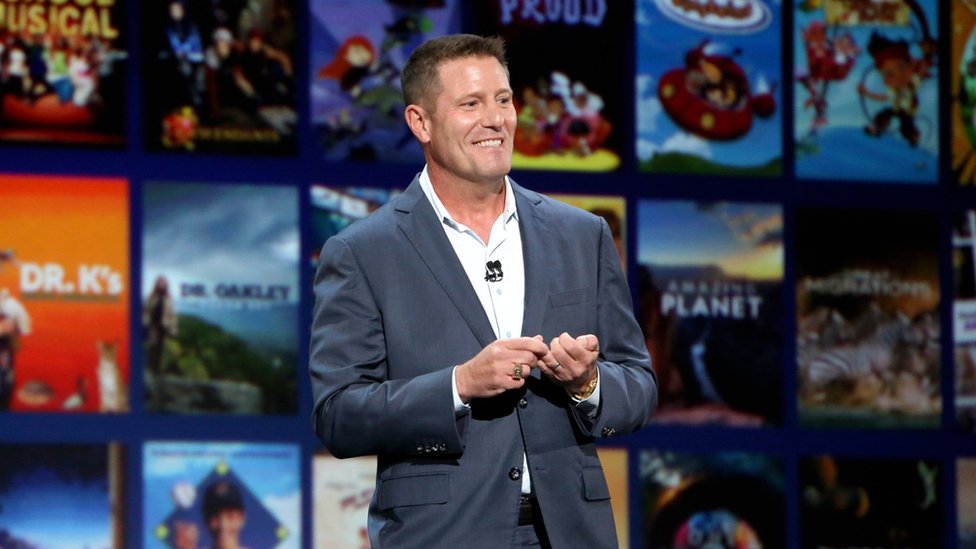
image captionTikTok’s chief executive Kevin Meyer quit last week as a result of the potential sell-off
It now includes two “civilian use” technologies that could directly impact TikTok:
interactive interfaces powered by artificial intelligence
personalised recommendations and notifications powered by data analysis
In theory, Bytedance would have to seek permission to sell the use of any related tech to a foreign entity, and it could take up to a month to get preliminary approval.
Were the company to be forbidden from including TikTok’s recommendation engine as part of a sale, it would in effect cripple the app.
That would mean a buyer would to have to develop a recommendation system of their own, making a smooth handover of control difficult to achieve.
Bytedance pledged to comply with the change to the law via a Chinese-language post on its news service Toutiao on Sunday night.
The firm’s lawyer Erich Andersen later added: “We are studying the new regulations that were released Friday. As with any cross-border transaction, we will follow the applicable laws, which in this case include those of the US and China.”
In other related developments:
TikTok has denied it is considering selling itself to rival video-sharing app Triller and a London-based investment firm. It told CNBC that “we are not and will not be in talks with them – still, we are flattered by how much they admire TikTok”
The UK prime minister’s advisers are split over whether Boris Johnson should publicly say he is in favour of Bytedance setting up global headquarters for TikTok’s remaining operations in London, according to a report in the Times. It quoted a government source as having said it is a “very sensitive” issue
An online poll has suggested that 40% of US adults support Trump’s intervention, while 30% oppose it. The survey of 1,349 adults was carried out by Reuters and Ipsos last week