Sunday, February 8, 2026
-9.5 C
Washington D.C.
Home Blog Page 103

TikTok: Oracle confirms being picked by Bytedance to be app’s partner

0

[ad_1]

By Leo Kelion
Technology desk editor

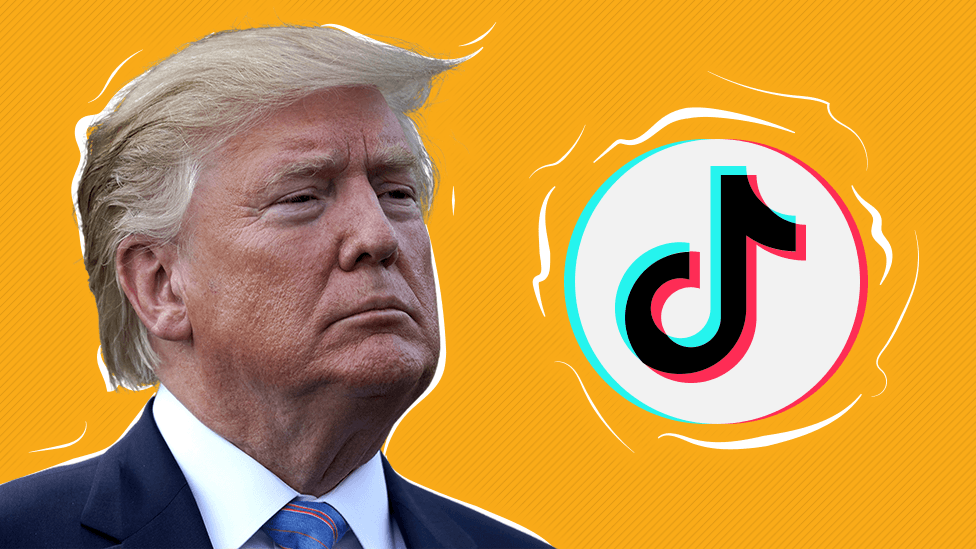
Trump and TikTok logo

US tech firm Oracle has confirmed that TikTok’s owner has formally proposed it become a “trusted technology partner” to the video-sharing app.

Full details of the tie-up have yet to be disclosed, but the aim is to avoid President Trump’s threat to shut down the Chinese-owned service in the US.

Trump has cited national security concerns, suggesting users’ data could be accessed by Beijing under current arrangements.

Current owner Bytedance denies this.

It says it has taken “extraordinary measures to protect the privacy and security of TikTok’s US user data”, which is stored in the States and Singapore.

Oracle is a database specialist without experience of running a social media app targeted at the general public.

Earlier in the day, the US Treasury Secretary Steven Mnuchin said that the Trump administration had been contacted by the American firm to discuss plans to make TikTok a US-headquartered company. He said the White House intended to review the idea this week.

Microsoft had also attempted to buy the platform, but revealed it had been rejected on Sunday.

Bytedance has yet to comment on the latest development.

Oracle’s shares were trading about 7% higher in mid-morning trade in New York.

“While I can see the upside for Oracle from a cloud perspective, it is hard not to think how much of this deal rests on politics rather than tech,” commented Carolina Milanesi from the Silicon Valley-based research firm Creative Strategies.

Oracle’s chairman, the billionaire Larry Ellison, is a supporter of Mr Trump and in February held a fundraiser at his California home to aid the Republican leader’s re-election campaign.

The White House is also taking a harsh line against other Chinese tech companies – including Huawei, Tencent and a number of artificial intelligence start-ups – restricting what business they can do with US counterparts without the administration’s approval.

President Trump had given TikTok’s owner Bytedance until this week to secure a deal.

Failure to do so would have seen US companies prevented from doing business with it from Sunday, and Bytedance being forced to give up TikTok’s US operations one way or another by 12 November.

The app’s US team sued the US government last month in an effort to challenge the moves.

Oracle was not the favourite to buy or otherwise link up to TikTok’s US arm – Microsoft was the early frontrunner.

But as time wore on, Microsoft became increasingly concerned about what it would be acquiring.

It became clear that China might attempt to block the sale of the technology behind the app’s powerful algorithm.

Privately there were concerns too that Microsoft was about to create a rod for its own back by becoming involved with a mass market, youth-focused social network – it already owns LinkedIn, but that caters for a very different audience.

Political bias, child safety issues and right-wing militias are just some of the problems TikTok has had to deal with in the last few months.

Even so, TikTok’s hundreds of millions of users make it an attractive proposition in a sector where size is everything: if all your friends are on a platform, you too are more likely to join.

Oracle has decided it’s worth the risk.

The big questions now are what exactly is Oracle’s involvement, and will the tie-up be approved by the US and Chinese authorities.

TikTok Timeline

image copyrightEPA

March 2012: Bytedance is established in China and launches Neihan Duanzi – an app to help Chinese users share memes

September 2016: Bytedance launches the short-form video app Douyin in China

August 2017: An international version of Douyin is launched under the brand TikTok in some parts of the world, but not the US at this time

November 2017: Bytedance buys lip-synch music app Musical.ly

May 2018: TikTok declared world’s most downloaded non-game iOS app over first three months of the year, by market research firm Sensor Tower

August 2018: Bytedance announces it is shutting down Musical.ly and is moving users over to TikTok

February 2019: TikTok fined in US over Musical.ly’s handling of under-13s’ data

October 2019: Facebook’s Mark Zuckerberg publicly criticises TikTok, accusing it of censoring protests

November 2019: The Committee on Foreign Investment in the United States (Cfius) opens national security investigation into TikTok

May 2020: TikTok hires Disney executive Kevin Meyer to become the division’s chief executive and chief operating officer of Bytedance

June 2020: India bans TikTok among dozens of other Chinese apps

July 2020: US Secretary of State Mike Pompeo, and then President Trump, say TikTok might be banned

August 2020: Microsoft and Oracle make rival approaches to acquire or otherwise operate TikTok in the US and three other markets. Mr Meyer announces he is leaving the company because the “political environment has sharply changed”

September 2020: TikTok says it has more than 100 million active users in Europe. It recently said it had a similar number in the US, and has been estimated to have more than 800 million engaged members worldwide

Related Topics

  • Social networks

  • TikTok
  • China
  • Donald Trump
  • United States

[ad_2]

Source link

TikTok: What is Oracle and why does it want the video-sharing app?

0

[ad_1]

By Cristina Criddle
Technology reporter

Oracle founder Larry Ellison

image copyrightGetty Images

image captionOracle founder and chairman Larry Ellison is worth about $75bn (£57.3bn), according to Forbes

Software giant Oracle is believed to be the frontrunner in the bidding war for short-form video app TikTok.

Microsoft dropped out of negotiations with Chinese-company Bytedance on Sunday night, after which

Reuters reported that Oracle would become its technology partner and assume management of TikTok’s US user data.

The partnership should address US security concerns but not be a complete sale, sources told the agency.

However, Chinese state media has said Bytedance will not sell its US operations outright, nor will it share TikTok’s source code.

Oracle’s security roots

Oracle sells database technology and cloud systems to businesses. It was one of the first companies to help clients structure their records in this way.

Co-founder and current chairman Larry Ellison named the company after the codename given to a project for its first customer, in 1975: the Central Intelligence Agency (CIA).

The firm was founded two years later and went on to complete contracts for the CIA, Navy Intelligence, Air Force Intelligence and the National Security Agency.

News site Gizmodo has detailed Oracle’s involvement with US government intelligence community, and says it is relationship that has been “frequently ignored by people who like to pretend Oracle was just another humble Silicon Valley start-up”.

But its clients and cloud-based services now extend far wider, from serving auto-makers including Mazda and Yamaha to retailers such as the UK’s Co-op and Debenhams chains.

Oracle’s technologies can be used to keep track of everything, Mr Ellison has said.

“The information about your banks, your checking balance, your savings balance, is stored in an Oracle database,” he said in Jeffery Rosen’s 2004 book The Naked Crowd.

“Your airline reservation is stored in an Oracle database. What books you bought on Amazon is stored in an Oracle database. Your profile on Yahoo! is stored in an Oracle database… Privacy is already gone.”

A safe choice?

The US administration claims TikTok and other Chinese apps are national security threats which is why – given its history in intelligence – Oracle might be considered a trustworthy option.

“On the surface, Oracle and TikTok don’t seem like bedfellows,” said Chris Stokel-Walker, author of a forthcoming book about the platform.

“Oracle is a relatively boring business-to-business company, whereas TikTok is a youth-centred, casual app.

“But there is underlying geopolitics. If [US President Donald] Trump’s fears around TikTok are rooted in security, the company would be a safer bet.”

image copyrightReuters
image captionPresident Donald Trump has previously indicated he would support Oracle’s involvement
Mr Ellison – who is ranked the world’s fifth richest person by Forbes – has been openly supportive of President Trump and held a fundraiser for him in February.

The president had previously said he thought Oracle was best placed to seal the TikTok deal.

“I think Oracle is a great company, and I think its owner is a tremendous guy,” Mr Trump said last month. “He’s a tremendous person. I think that Oracle would be certainly somebody that could handle it.”

TikTok deadlines:

  • 15 September: Deadline given by President Trump for Bytedance to find a deal
  • 20 September: Executive order due to come into effect prohibiting companies under US jurisdiction doing business with Bytedance
  • 12 November: Second executive order comes into effect, giving Bytedance a deadline to fully divest the US assets of TikTok
But any deal would require the approval of both American and Chinese governments – and Chinese state media has reported that Bytedance will not sell to the company to Oracle.

Oracle has been accused of hostility towards China, after firing 900 staff from its team in the country last year, in the same week additional tariffs on Chinese goods were introduced in the US.

Employees blamed tensions between the US and China for the cuts.

media captionHow the US-China trade war has changed the world

‘Tech partnership’

It is understood that Oracle’s involvement in TikTok will not be an outright sale but instead a “tech partnership”, the Wall Street Journal and Reuters report.

That suggests the US firm’s control over the business would be limited.

Two weeks ago, China announced new government restrictions on tech exports. They mean some technologies involving artificial intelligence techniques need government approval before any sale to a foreign entity takes place.

Many view the way TikTok decides which videos to recommend to whom and when as being its key asset, and it may be that Oracle will not be allowed to know exactly how it works or make use of it for other purposes,

“A deal where Oracle takes over hosting without source code and significant operational changes would not address any of the legitimate concerns about TikTok, and the White House accepting such a deal would demonstrate that this exercise was pure grift,” Alex Stamos, former chief security officer at Facebook, tweeted.

But another expert thinks the partnership could work.

“The security element with Oracle could ease tensions, but it can also help TikTok be a bit more mature in its outlook,” said Tamara Littleton, founder of The Social Element consultancy.

“TikTok is struggling to control its content at the moment, and its revered algorithm can work against it sometimes. Oracle’s experience could help to fix some of these problems.”

TikTok and Oracle both declined to comment when contacted by the BBC.

Related Topics

  • TikTok

  • China
  • Microsoft
  • CIA


[ad_2]

Source link

OnePlus buds seized as ‘fake Apple AirPods’ by US customs

0

[ad_1]

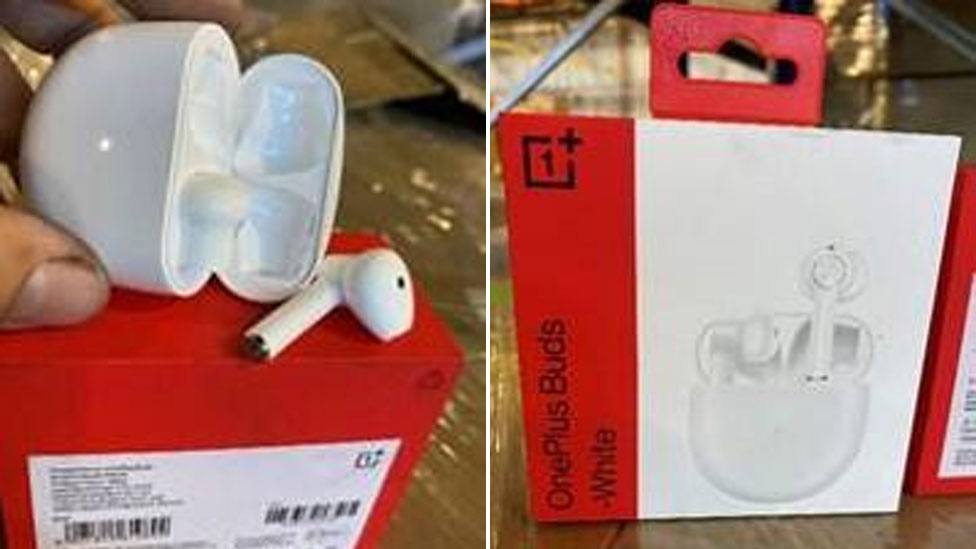
A split screen shows two images of the alleged counterfeit airpods, including a box with the logo and text of the OnePlus brand

image copyrightCBP

image captionCBP posted these images of “counterfeit Apple Airpods”

Thousands of “counterfeit Apple AirPod earbuds” seized entering the US by customs officials appear to be genuine wireless earphones made by OnePlus.

“That’s not an Apple,” Customs and Border Protection (CBP) tweeted.

And an accompanying press release lauded “the vigilance and commitment to mission success” of the officers.

But the photograph tweeted by CBP clearly shows OnePlus-branded earphones. And OnePlus simply replied on Twitter: “Hey, give those back.”

‘Various dangers’

Officers at John F Kennedy International Airport had seized 2,000 “counterfeit Apple AirPod earbuds from Hong Kong destined for Nevada”, CBP said.

“CBP officers are protecting the American public from various dangers on a daily basis,” the New York field operations director added.

“If the merchandise were genuine”, the press release said, the earphones would be worth $398,000 (£310,000) or $199 a pair.

But OnePlus’s earphones sell for less than half that amount.

Related Topics

  • Copyright

  • United States
  • Apple


[ad_2]

Source link

This world-renowned Gambian musician is building an academy so children can study their own culture — without leaving Africa

0

Written by Rachel Wood, CNN

She has found international fame as a musician, but Sona Jobarteh has a bigger mission — to use culture to empower Africans to reform their countries.

Jobarteh has been performing with the kora — a 21-stringed African harp — on the world stage since she was five years old, becoming the first professional female kora player in the West African country of The Gambia. You can hear her vocals on the soundtrack to the movie “Mandela: Long Walk to Freedom.”

As well as being an acclaimed performer, Jobarteh is a scholar in the field of traditional West African Mande music, and it was during her studies at SOAS University in London that she came to a realization.
“[SOAS] has one of Europe’s largest libraries containing African literature and resources — an absolutely amazing place,” she told CNN. “But why should Africans leave Africa to go and study their own culture? This is something that didn’t sit well with me.”

The Gambia’s first female professional kora player is hoping to educate the next generation

Wanting to give Gambians a sense of pride in their own culture, Jobarteh is now building an expansive campus for academic and cultural studies — complete with concert hall, amphitheater and recording studio.

History of the academy

Jobarteh founded The Gambia Academy in 2015, teaching school-age children a mainstream curriculum alongside African history, culture and traditional music.

Her idea was to create a course of study that highlighted the country’s culture in a way that could be replicated and implemented across the country.

The Academy started with 21 students — “to symbolize the kora’s 21-stings,” said Jobarteh — in a makeshift facility in Farato, a rural town in western Gambia.

Sona Jobarteh playing the kora during a World Music Institute concert at Symphony Space, New York, June 2019. Credit: Jack Vartoogian/Getty Images/Archive Photos/Getty Images

More than half of the children were orphans from rural communities, who had little or no access to education. The intake has since expanded to 40 students, whose fees are paid by Jobarteh.

But with a growing waiting list of new applicants, the academy is expanding to a purpose-built site in Kartong, southwestern Gambia, with capacity for 500 students, ranging in age from eight to 18.

The academy also plans to invite international students and musicians to further the educational experience of the children.

“Center for cultural knowledge”

Building in a remote location in rural Gambia comes with plenty of challenges: “heat, humidity and heavy downpours” along with “termite infestation and snakes,” said the British project manager Ron Mitchell in an interview.

But for Mitchell, the project is worth the hardship. “For the first time there will be a place of learning in a bright, natural setting that blends African tradition, arts and culture with academia that allows disadvantaged young people to learn alongside adults from all over the world,” he said.

The design seeks to use various sustainable, locally sourced materials including timber, natural straw and compressed earth blocks. The site will also be self-sufficient, using solar power for water and electricity.

The most eye-catching elements are the “five specialist cultural facilities” — including a multimedia department, concert hall and archive library — which Jobarteh hopes will form a “center for cultural knowledge.”

The project has received $45,000 from UNICEF, enough to begin construction in November on the Junior Department’s main building. Meanwhile, fundraising is underway for the remainder of the estimated $3 million total cost, with the aim of completing the full build by the end of 2021.

Source link

Months after Covid-19 infection, patients report breathing difficulty and fatigue

0

Gahan, a clinical psychologist in Shrewsbury, United Kingdom, hasn’t been able to return to work.

The disease causes what she calls “storms,” disabling periods when she feels shortness of breath, numbness in her hands and feet and her heart rate shoots up from simple tasks. Even taking a shower is possible only during an occasional respite in symptoms.

“In May and June, I could barely talk because I was so ill,” she said.

Before contracting the disease in early April, the mother of two ran three times a week and had a regular yoga routine.

“I can only walk as far as the corner,” she said. “In terms of running, I can’t imagine when that will happen, if ever.”

She is one of thousands around the world for whom Covid-19 has turned into a chronic condition. Gahan and other Covid-19 “long haulers” feel they aren’t yet getting recognition for an illness that has disabled them for months, with no end in sight.

“I’m a clinical psychologist, and this is not anxiety,” she said. “If doctors just say ‘We don’t know,’ it’s better than saying Covid symptoms only last two weeks.”

Many hospitalized for Covid-19 at risk to become ‘long haulers’

About three-quarters of those hospitalized for Covid-19 could become long haulers, according to a paper uploaded to the pre-print server medRxiv on August 14 without having yet been vetted by outside experts or accepted for publication.

Researchers from the Academic Respiratory Unit of the North Bristol NHS Trust in the UK looked at 110 Covid-19 patients, whose illnesses required hospital stays for a median of five days between March 30 and June 3.

I can't shake Covid-19: Warnings from young survivors still suffering

Twelve weeks after patients were released from the hospital, 74% of them reported symptoms, including breathlessness and excessive fatigue.

Despite these symptoms, however, 104 of the 110 patients in the study had normal basic blood test results, with just 12% showing an abnormal chest X-ray and 10% showing restrictive lung function through spirometry tests.

The British Medical Journal released new guidance for health providers in August on how to treat long-haul Covid-19 patients, estimating that up to 10% of all people who have tested positive could develop a prolonged illness. The guidance includes specific blood tests to perform, possibly referring patients to pulmonary rehabilitation and having them use pulse oximetry at home to measure oxygen saturation in the blood.

Results like these fly in the face of a narrative that took hold early in the pandemic, in which many medical professionals believed that the average Covid-19 patient would be sick for a couple weeks, clear the virus and be fine afterward.

That turns out not to be the case for everyone. The BMJ guidance cited “weak or absent antibody response, relapse or reinfection, inflammatory and other immune reactions, deconditioning, and mental factors such as post-traumatic stress” as contributing to longer-term symptoms. It acknowledged that similar parallels had occurred in patients with SARS and MERS.

“The classic case we all have in our hands is not always what really happens,” said Dr. MeiLan King Han, a pulmonologist and professor of medicine at the University of Michigan. “For the patients I have followed, many continue to complain of cough, breathing issues and severe fatigue long after their first infection.”

Long haulers and dysautonomia

One of the key issues in caring for each long-haul Covid-19 patient is to figure out how many of their symptoms can be chalked up to the heart and lungs and how much of the illness is actually the result of a deeper form of neurological dysfunction the coronavirus has unspooled, according to Noah Greenspan, a New York-based physical therapist and founder of the Pulmonary Wellness Foundation.

Before engaging in physical or respiratory therapy, he asks that all his patients get a full workup from their doctor to rule out a cardiac condition, stroke or pulmonary embolism before starting physical therapy.

Some patients’ symptoms are mild and can start a more traditional rehab plan, he said, “but there are others, which are turning into the biggest group of people, which are these long haulers.”

The primary trend across the Covid-19 long haulers that Greenspan is working with is a condition called dysautonomia, a condition marked by a miscommunication between the autonomic nervous system and the rest of the body.

The autonomic nervous system regulates automatic body functions such as breathing, sleep and digestion. When it’s not working, symptoms can present in myriad different ways, depending on the person.

“Reach into a bag of symptoms and pull out a bag of symptoms, and that’s what they have for the day,” Greenspan said. “It’s a twisted ball of yarn and takes a week to unravel one string.”

While shortness of breath and cardiovascular problems do present in his patients, Greenspan said, these are not usually the most common underlying cause of their misery.

Gahan and others with long-haul Covid-19 symptoms face a condition called postural orthostatic tachycardia syndrome, which refers to a sharp rise in heart rate that occurs when moving from a reclining to standing position. The pull of gravity causes blood to pool in the legs. This condition can cause dizziness, lightheadedness and fainting.

Chronic fatigue syndrome a possible long-term effect of Covid-19, experts say

“Their heart rate goes up 50 to 75 points if they get up to get water,” Greenspan said. “They have fast heart rates that don’t have anything to do with what they’re actually doing, that are not commensurate with their workload.”

Many patients are exhibiting neurological symptoms consistent with myalgic encephalomyelitis/chronic fatigue syndrome, according to the BMJ and National Institute of Allergy and Infectious Diseases Director Dr. Anthony Fauci. That diagnosis requires at least six months of symptoms, a benchmark most long haulers haven’t yet reached.

For many, lung damage not the biggest issue

Many Covid-19 patients feel that the medical system is gaslighting them, telling them there’s nothing wrong even though their whole lives have been upended by Covid-19’s aftermath.

Corey Coopersmith, a 36-year-old fitness consultant in Las Vegas, hasn’t been able to work since first getting sick in late February. He suffers a constant ebb and flow of symptoms, and yet visit after visit to medical specialists has turned out a series of “normal” lab tests.

“A month ago, I had a pulmonary exam, and I got 120% on the gas exchange test,” Coopersmith said, noting the doctor told him, “Your lung function is amazing.”

But a breakthrough came when he finally visited an immunologist who performed tests that indicated abnormally low function of immune cells, including T cells and B cells.

“Have you been tested for HIV?” the immunologist asked Coopersmith, he recalled. “Your blood work looks like someone about to get AIDS.”

An immunologist finally found disturbances in Coopersmith's immune system that appeared to be on par with HIV/AIDS even though he doesn't have HIV.

A mixed martial arts fighter in his 20s, Coopersmith was in great shape when he contracted Covid-19 in February, boasting of a resting heart rate of 58 beats per minute.

Now though, when he wakes up in the middle of the night to go to the bathroom, POTS can drive his heart rate to 200.

To make it possible to sleep under his new constraints, he bought a continuous positive airway pressure machine, a device with a face mask that pushes oxygen into his lungs.

“I lie there gasping for air, fighting for life,” he said.

For many, lung damage not the biggest issue

Coopersmith is one of many Covid survivors trying to grasp why he feels so breathless even though his lung function is excellent.

“I feel like my lungs have recovered quite well,” Gahan, the clinical psychologist in the UK, said.

Her main issue has been pinpointing what has been causing the storms of illness, which are primarily neurological symptoms, including migraines and numbness in her feet and hands. She feels they can be explained by dysautonomia.

“I can’t do anything except to just go to bed,” she said, noting how lights and sounds and emotional stressors exacerbate her ongoing sickness. “I can’t stand any interaction.”

Patients hope their stories of halted recoveries might dissuade others from taking risks with infection by traveling, partying or gathering in large groups prior to development and distribution of a vaccine.

“It’s not about fatigue. It’s about really nasty symptoms that take over your whole life for who knows how long,” Gahan said. “Think about people like me when you’re thinking about what decisions you should make.”

Source link

Mo Salah hat trick sinks Leeds in seven-goal Premier League thriller

0

The away side came from behind three times and looked set to be earning a precious point until Salah converted an 89th-minute penalty after Leeds’ club record signing Rodrigo fouled Fabinho to concede the spot kick.

Promoted as champion from the English second flight last season, Leeds put on a command performance to push Liverpool all the way in a match that would have graced a packed stadium rather than a scattering of squad players and officials.

Egyptian star Salah, who looked sharp throughout, proved the difference, putting his side in front with his first successful conversion from the penalty spot after four minutes and completing the first half scoring with a laser-like finish to edge his side 3-2 ahead in an extraordinary five-goal first half.

Mo Salah powers home Liverpool's third goal and his second in a pulsating clash at Anfield against Leeds United.

Leeds, playing with the high-tempo pressing style so typical of Bielsa’s sides, leveled at 3-3 on Mateusz Klich’s 66th minute goal, which he started and finished. But Leeds could not hold out under intense pressure from Jurgen Klopp’s men.

Returning to the top-flight after 16 long years, Leeds could scarcely have made a poorer start as new signing Robin Koch conceded a penalty as Salah’s shot deflected from his knee onto his outstretched arm.

Leeds protested to referee Michael Oliver, but his decision was confirmed by the video assistant referee and Salah blasted the ball home down the middle.

But any thoughts of an easy home victory were quickly put to bed as new England international Kalvin Phillips found Jack Harrison with a raking long pass and the on-loan Manchester City man did superbly to cut inside and beat Alisson Becker with a powerful low shot on 12 minutes.

Jack Harrison of Leeds United scores his team's opening goal at Anfield as he shoots home past Liverpool defenders Trent Alexander-Arnold and Virgil Van Dijk.

Liverpool went ahead again eight minutes later as Virgil Van Dijk powered home a header from an Andy Robertson corner but the Dutch defender was at fault soon afterward for the second Leeds equalizer.

He miscued a clearance and Patrick Bamford was on hand to score neatly to make it 2-2.

Both sides were showing defensive frailty and it was another indifferent clearance from a free kick that afforded Salah the opportunity for his second goal, controlling quickly before powering his shot into the top left of the Leeds net.

The second half was a calmer affair, with Leeds matching Liverpool for possession and deservedly leveling through Klich’s fine strike until striker Rodrigo, making his debut, mistimed his challenge to concede a needless penalty that Salah was never going to miss.

Mo Salah wrapped up victory for Liverpool with his third goal and the side's fourth in the 4-3 opening day win over Leeds United.

Salah acknowledged the part the opponent had played in a pulsating start to the new season.

“Leeds are a tough team. They had a great game and reacted really well,” he told Sky Sports.

“I’m happy about the result and we have to keep on improving. It’s important for me to stay focused. We had a good game.”

Klopp summed up the thoughts of many after a memorable clash.

“What a game. Football as it’s best. What a spectacle,” the Red boss said.

Lacazette at the double

The opening goal of the Premier League campaign was scored by Alexandre Lacazette as he helped Arsenal to a thumping 3-0 win over promoted Fulham in the early kick off.

Fulham started brightly but that initial good work was undone by sloppy defensive work as Arsenal’s new signing Willian set up the Frenchman in a goalmouth scramble for his ninth-minute strike.

It is the second time Lacazette has scored the first goal of the Premier League season, achieving the feat in 2017-18 against Leicester City.

Arsenal's French striker Alexandre Lacazette scores the opening goal of the English Premier League season in his side's 3-0 win over Fulham.

Fulham fought hard to retrieve the situation but the Cottagers fell further behind at the start of the second half as Arsenal’s new signing Gabriel Magalhaes scored after a corner, the ball finding the net off the top of his shoulder.

The icing on the cake for Mikel Arteta’s FA Cup winners came later in the second half as a sublime team move saw Pierre-Emerick Aubameyang get off the mark for the season to make it 3-0 with his 11th goal in 11 games for the Gunners.

In the afternoon match, Wilfried Zaha scored the only goal as Crystal Palace beat Southampton 1-0 at Selhurst Park.

Zaha, linked with a move away from Palace, volleyed home in the 13th minute on an assist by Andros Townsend.

Southampton pressed hard for an equalizer with last season’s top scorer Danny Ings denied by a fine late save from home keeper Vicente Guaita.

Source link

Trump rally attendees open up to Lawrence Jones about their support: ‘He tells it like it is’

0

Attendees of President Trump’s Thursday rally in Michigan told “Hannity” election correspondent Lawrence Jones that they support the Republican because he “tells it like it is.”

“Why are you supporting the president?” Jones asked one woman wearing a “MAGA” hat.

“Because he tells it like it is,” she answered. Two other women told Jones that “he’s real.” One man indicated that Trump “tells the truth.”

BIDEN LEADS 2020 RACE, BUT PLURALITY THINKS TRUMP WILL WIN ELECTION: POLL

“If you ask me, I think we’ve been surrounded by a bunch of people that aren’t telling us the truth,” he told Jones.

Others at the rally said they didn’t believe polling that showed former Vice President Joe Biden beating Trump in the 2020 election.

When asked whether Biden had a shot at winning Michigan, the first woman said “no, he’s got to be conscious.” One man similarly criticized Biden’s public appearances, saying that “he can’t even finish a whole sentence.”

CLICK HERE TO GET THE FOX NEWS APP

A Monmouth University poll published earlier Thursday showed Biden leading Trump by nine percentage points among registered voters.

However, a plurality of voters (48 percent versus 43 percent) said they thought Trump would win the election.

Fox News’ Paul Steinhauser contributed to this report.

Source link

‘Scammer cloned my business on Instagram’

0

[ad_1]

By Jane Wakefield
Technology reporter

Emma Heathcote-James

image copyrightEmma Heathcote-James

In the last weekend of August, when Emma Heathcote-James had been looking forward to a relaxing bank-holiday break, she instead found herself fighting to save her company’s reputation.

She had just discovered the Instagram page for her beauty-product business, which she had spent 12 years building up, had been cloned.

“For some reason the scammers tagged me in one of the photos, which seems like it was probably a mistake,” she says.

And this alerted her to the cloned page, where the only discernible difference from the legitimate Little Soap Co’s page was an extra “o” at the end of the name.

PayPal details

As well as making a carbon copy of the page, the scammers were intent on making some money.

“The account went private and we discovered that they spent the entire evening on bank-holiday Monday contacting hundreds of our followers, who had entered our latest competition, saying they had won and asking for PayPal details,” Emma says.

At least one of her customers responded but she does not know how many more were affected or who lost money.

And trying to persuade Instagram to remove the fake page proved frustrating.

Square one

“It was impossible to speak to a human at Instagram,” Emma tells BBC News.

“We couldn’t log it as a business-impersonation account as the form to fill in takes you on a loop with nothing at the end, instead you are back to square one.

“It is like they don’t want to be contacted.

image copyrightLittle Soap Company
image captionThe Little Soap Company has 7,000 followers on Instagram

And Emma finally told a person or a software bot – she is not sure which – on Facebook Messenger about what she regarded as trademark infringements.

“I got an email back saying it wasn’t an infringement but that it breached the terms and conditions of the community guidelines,” she says.

“And the account was taken down.”

‘Very fortunate’

But it was a “cursory” email, devoid of any personal touch.

“It was like Facebook was saying, ‘Done – next,'” Emma says.

By then the issue had also been logged with the police, who told Emma such cloning was “rife”.

“We were very fortunate how speedily it was taken down,” she says.

“But we had three of us working on it.

“Not all businesses have this resource.”

‘Iron fortress’

And she remains angry about the way it was dealt with.

“Every other digital platform we pay to use has good customer service, whereas Facebook, which is a good shop window for many businesses, is very different,” Emma says.

“It feels like an iron fortress.

“It’s very hard to speak to anyone.

“And the chatbots aren’t yet intelligent enough to help.”

Fake accounts

Facebook told BBC News: “We have removed the accounts brought to our attention for inauthentic behaviour.

“We’re continuously investing in our teams and technology to identify and remove fraudulent activity, and have donated £3m to Citizens Advice to deliver a UK scam action programme, which spreads the word on how to avoid scams and offers support to people who have been affected.”

Every day, Facebook’s detection technology blocks millions of attempts to create fake accounts.

But account cloning remains a problem for both Facebook and Instagram, with individuals targeted alongside businesses.

Twitter and LinkedIn have to tackle similar scams.

Bitcoin scam

Cloning is remarkably easy to do.

image copyrightJake Moore
image captionJake Moore cloned his own account to see how easy it was to profit from it

In a blog, security specialist at anti-virus company ESET Jake Moore explains how he copied his own Instagram account in an afternoon – and, with a sob story about being locked out of his bank account as well as social media, persuaded one of his followers to send him money

He had the following advice:

  • To avoid being cloned, search for your hashtags or reverse image search on Google to see if the pictures you have posted appear elsewhere
  • If you are cloned, take a photo of yourself with some official ID and email Facebook
  • If you receive a message from someone you don’t know requesting funds, do not send money
  • If you receive a message from someone you know asking for money, check with them the message is real

Emma is certainly planning on keeping a very close eye on any suspicious activity around her brand and has since found another cloned account and two cloned versions of her personal Instagram page – all now removed.

“The whole thing is slightly sinister,” she says

More on this story

[ad_2]

Source link

TikTok admits restricting some LGBT hashtags

0

[ad_1]

By Chris Fox
Technology reporter

TikTok logo

TikTok has acknowledged that it restricts LGBT-related hashtags in some countries as part of its “localised” approach to moderation.

A

report by the Australian Strategic Policy Institute (ASPI) think-tank said many LGBT hashtags were “shadow-banned” in Bosnia, Jordan and Russia.

A shadow ban limits the discovery of content without indicating that a particular hashtag is on a ban list.

TikTok said that some hashtags were restricted to comply with local laws.

According to the ASPI, terms that were not linking to content included:

  • “gay” in Russian and Arabic
  • “I am a lesbian” and “I am gay” in Russian
  • “transgender” in Arabic

TikTok said that while some terms were restricted to comply with local laws, others were limited because they were primarily used to discover pornographic content.

It added that some English phrases and some compound phrases in Arabic had been moderated by mistake, and that it had fixed the issue.

And it said some of the hashtags reported by the ASPI did not reveal any content because they had never been used by a video-maker on TikTok.

It said it was “deeply committed to inclusivity”.

Many LGBT social media users will be unsurprised by these findings – especially those who live in one of the “shadow-banned” nations, where the struggle to be themselves extends far beyond hashtags on the internet.

In June 2020, TikTok branded itself as supportive of LGBT Pride, and the company made donations to organisations supporting LGBT people.

While TikTok may believe in “accountability and transparency”, their algorithm keeps getting caught out for discrimination.

One TikTok user living in South East Asia told me, while they were disappointed that their gender identity was being categorised as inappropriate in their native language, they knew the ways around the bans and frequently used them.

They added: “That’s just part of what being LGBT in 2020 is.”

LGBT rights group Stonewall said social media platforms such as TikTok provided a “vital community hub” for LGBT people, “particularly for those living in countries where they can face persecution for being themselves”.

“While we understand why local laws my affect some restrictions, it’s crucial TikTok follows up its statement of support for LGBT creators with action to tackle shadow banning of LGBT hashtags,” said Stonewall’s head of communications, Robbie de Santo.

In a statement, TikTok said: “We believe that accountability and transparency are essential to facilitating trust with our community. As part of this, we’ve committed to making our moderation policies, algorithm, and data security practices available to experts, which no other company in our space has been willing to do.”

In February, transgender users complained of censorship on TikTok after many had posts removed from the video-sharing platform.
And in December 2019, it was revealed that videos by disabled users were deliberately prevented from going viral by the app’s moderators.

Related Topics

  • TikTok

  • LGBT
  • Censorship
  • Social media

[ad_2]

Source link

Super telescope’s giant camera spies broccoli

0

[ad_1]

Broccoli imageImage copyright
LSST Camera Team/SLAC/VRO

Image caption

A head of Romanesco recorded across the 3,200 megapixels of Vera Rubin’s camera detector

Presentational white space

How do you test the new sensor for the world’s largest digital camera? You take a picture of broccoli, of course.

This might sound bizarre but the intricate shapes found in the Romanesco version of this plant are a good check that you’re capturing lots of detail.

And for the camera that’s to be fitted to the Vera Rubin Observatory in Chile – performance is everything.

This 3.2 gigapixel device is going to help unlock some of the key outstanding questions in astronomy.

Who knows? It might even get us closer to understanding those cosmic head-scratchers “dark energy” and “dark matter” which appear to be controlling the evolution of so much of what we see when we look up.

Focal planeImage copyright
J.Orrell/SLAC National Accelerator Laboratory)

Image caption

The focal plane is made up of 189 individual sensors, or charge-coupled devices

Presentational white space

The VRO will do this by making what can only be described as a stupendous map of the sky.

The observatory is going to survey its entire field of view every few nights for 10 years.

Not only will Rubin clock the positions of billions of stars and galaxies, but it will also catch anything that moves or flashes. It will be a treasure trove of data that’ll keep scientists busy for decades.

But to undertake such a survey, the VRO needs a special camera – like the one now being assembled at the SLAC National Accelerator Laboratory in California.

Pin hole set-upImage copyright
J.Orrell/SLAC National Accelerator Laboratory)

Image caption

To test the camera detector, the team used a pinhole box to project light on to the sensors

Presentational white space

At its heart is a 64cm-wide focal plane made up of 189 individual sensors, or charge-coupled devices (CCDs). Getting them all securely and precisely mounted and their complex electronics talking in unison has been an immense challenge.

But the pictures released on Tuesday demonstrate the task has been completed successfully.

The SLAC team isn’t yet in possession of all the camera’s components, such as its lenses, so it used a 150-micron pinhole to project images on to the CCD array.

The brassica plant was deliberately chosen for its very elaborate surface structure. Innumerable lumps and bumps. A tonne of detail to pick out.

Just how good are the pictures? If you wanted to display them full size at full resolution, you’d need 378 4K ultra-high-definition TV screens.

Artwork for experimental set-upImage copyright
Greg Stewart/SLAC National Accelerator Laboratory

“If we’re to complete this survey of the sky, we’re going to need a big telescope and a big camera,” explained VRO director Steve Kahn.

“This three billion pixel camera will cover about 10 square degrees of sky; and to give you a feel for that, it’s about 40 times the size of a full Moon. And we’ll be taking pictures across the sky essentially every 15 seconds,” he told BBC News.

“We’ll get very deep images of the whole sky. But almost more importantly, we’ll get a time sequence. We’ll see which stars have changed in brightness, and anything that has moved through the sky like asteroids and comets.”

Image inspectionImage copyright
J.Orrell/SLAC National Accelerator Laboratory)

Image caption

Getting all the individual CCDs and their electronics working in unison was an immense challenge

Vera Rubin is principally an American project, but with a strong international dimension.

UK scientists are expected to play a big part in the analysis of data, having a lot of expertise in sky survey work.

The VRO has been in the news recently because of its potential vulnerability to the satellite mega-constellations that are now being launched.

SummitImage copyright
Rubin Observatory/NSF/AURA

Image caption

The VRO is being constructed atop Cerro Pachón, a 2,682m-high mountain in northern Chile

Presentational white space

Large numbers of low-orbiting telecommunications spacecraft streaking through the camera’s field of view could ruin its images.

The largest of the new mega-constellations – at present – is the one being lofted by the entrepreneur Elon Musk and his SpaceX company.

Prof Kahn said the VRO was engaged with Mr Musk and that engineers were working on solutions to limit the interference.

The observatory director said better engagement was now needed from the British-Indian-owned OneWeb company, however.

Vera RubinImage copyright
LSST Camera Team/SLAC/VRO/Carnegie Institution

Image caption

In her honour: Vera Rubin (1928-2016) was an American astronomer who helped pioneer the concept of dark matter

Presentational white space

This network’s satellites could eventually pose a bigger problem than even SpaceX because the spacecraft are higher in the sky and will stay in the VRO’s field of view for much longer.

“The UK astronomy has assembled a large collaboration so it might be helpful for them to work on getting OneWeb to cooperate,” Prof Khan told BBC News.

“These problems are not completely insoluble but you need reasonable cooperation.”

It’s expected the VRO’s camera will start taking images of the sky – as opposed to heads of broccoli – in late 2022.

Broccoli in a boxImage copyright
J.Orrell/SLAC National Accelerator Laboratory)

Presentational white space


[ad_2]

Source link