Sunday, February 8, 2026
-8.4 C
Washington D.C.
Home Blog Page 100

The tech that may help make worship Covid-secure

0

[ad_1]

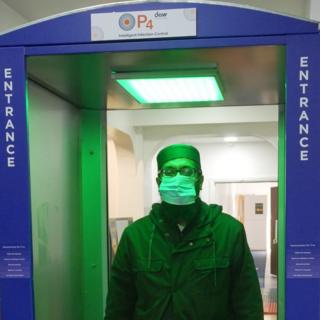
Man walking through sanitiser in mosque

A Bradford mosque is trying out new equipment designed to prevent the spread of coronavirus. Dr John Wright, of the city’s Royal Infirmary, takes a look and finds out how other places of worship have been adapting to pandemic conditions. He also hears about a trial in the US to test whether prayer can help Covid patients in intensive care.

It is a telling reflection on our society that the road to normality is lined with pubs, shops and restaurants. When lockdown ended, the government’s priority was to get people back on the high street, and of course businesses badly needed their support. But it’s interesting that our economic health takes precedence, while our spiritual health remains optional.

The closure of churches, mosques and temples during lockdown left a gaping hole in many people’s lives, and their re-opening has brought a welcome return of both religious and social connectedness, particularly for older people.

We know from the dark days of the peak of the pandemic that religious settings hosted some of the super-spreading events that fed the transmission of infection: weddings, funerals and even choirs. After the lifting of lockdowns, churches have been the source of outbreaks in South Korea and the US. So the re-opening of places of worship remains a challenge, and it’s one they have had to face without financial help from the Chancellor.

I visited one of Bradford’s mosques with my good friend Zulfi Karim, who, as well as being the president of the city’s Council for Mosques, is a Covid-19 survivor – and only just. He picked up the virus right at the start of the pandemic and had a relentless and gruelling illness followed by a lingering debilitation that has lasted over six months.

The al-Markaz ul Islami mosque, based in a converted mill, is a focal point for the local Muslim community as well as a spiritual home. Like all other mosques in the city, it closed down during lockdown and its congregation adapted to praying at home. With the lifting of lockdown, the imam recognised the importance of providing a safe space for his congregation and worked with two local GPs, Tahir Shaheen and Shazad Ali, to create a Covid-secure place of worship.

Image caption

Zulfi Karim is sprayed with jets of sanitiser

They showed me how they have redesigned the mosque with the latest technology to screen for fevers and check that face masks are being worn. An airport-style security booth sprays a mist to disinfect all visitors and a clever ventilation system checks the purity and circulation of the air.

“In the lockdown people were praying at home, but there are certain prayers that are only valid if they’re in congregation, like Friday prayer. Our numbers are now restricted; we have capacity for just 10-15% of our normal capacity given the restrictions. We have many more people wanting to come than we can accommodate,” Zulfi tells me.

Since early July, an online booking system has been in place. When people walk through the door, the new equipment instantly measures their body temperature and anyone with a fever is guided to a quarantine room where they can be checked again, imam Muhammad Ishtiaq tells me.

Those whose temperature is normal proceed to a sanitising station, and from there to the prayer room, where there are markings on the floor at one metre distances. The equipment was generously donated by a company called P4 Technology and the mosque will trial it for a year.

“If the technology allows us, and it’s been approved, we are hoping that we will be allowed to take the face masks off and stand side by side,” the imam says.

“If it benefits us, we want all other religions and groups to be able to benefit from it,” adds Dr Shazad Ali.

Front line diary

Image copyright
Ian Beesley

Prof John Wright, a doctor and epidemiologist, is head of the Bradford Institute for Health Research, and a veteran of cholera, HIV and Ebola epidemics in sub-Saharan Africa. He is writing this diary for BBC News and recording from the hospital wards for BBC Radio.

At the Sikh temple on Leeds Road, in Bradford, volunteers have been checking that worshippers are wearing face masks. People have been encouraged to remain at a distance of two metres and singers have been located behind glass screens. Earlier this month, though, someone who’d attended the temple tested positive for Covid-19 and all those present on the same day had to self-isolate for two weeks.

The Bishop of Bradford, Toby Howarth, tells me that communion in the cathedral is now very different. Only the priest can receive the wine; the priest then walks down the aisle putting the bread into each person’s hand, disinfecting his or her own hands every time. In some churches, services are held online, or worshippers can watch a recorded sermon and then go to their church for communion.

“Then there are other places that deliver the liturgy to people’s houses, and everyone says the liturgy at the same time every week, knowing that everyone else is saying the same thing,” Bishop Toby says. “So there is this sense that even if I can’t see you, we are doing it at the same time – and almost with a heightened awareness of people saying it because they’re not in the same building.”

One lovely example of where religion and science have come together in the hope of fighting Covid-19 is in Kansas, in the US, where doctors and religious leaders are carrying out a trial of prayer for Covid-19 patients in intensive care.

This is no Mickey Mouse trial either. A double blind, randomised controlled trial of 1,000 patients, trials don’t get much more scientifically robust than that. Now I suspect that most patients would be a little concerned if on the morning ward round their doctors dropped to their knees and started calling out for God’s intercession. It certainly wouldn’t fill you with optimism.

In this trial, however, the prayer is done remotely – a universal prayer from five denominations (Christianity, Hinduism, Islam, Judaism and Buddhism) with the control group just getting standard medical care. We are constantly searching for more effective treatments, so let’s wait and see whether prayer is as effective as dexamethasone.

Follow @docjohnwright and radio producer @SueM1tchell on Twitter


[ad_2]

Source link

The Long History of ‘Hidden Earpiece’ Conspiracy Theories

0

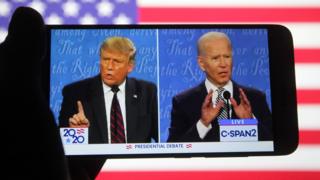
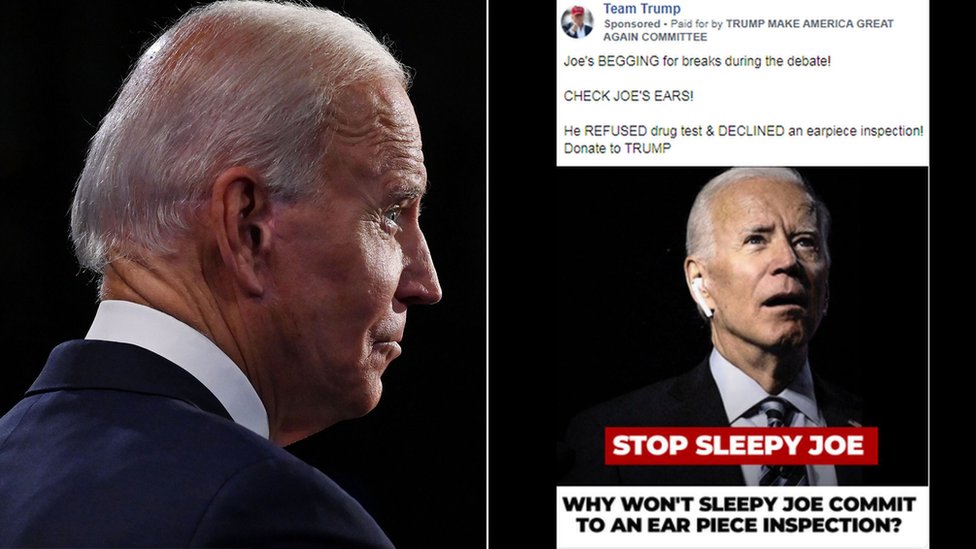
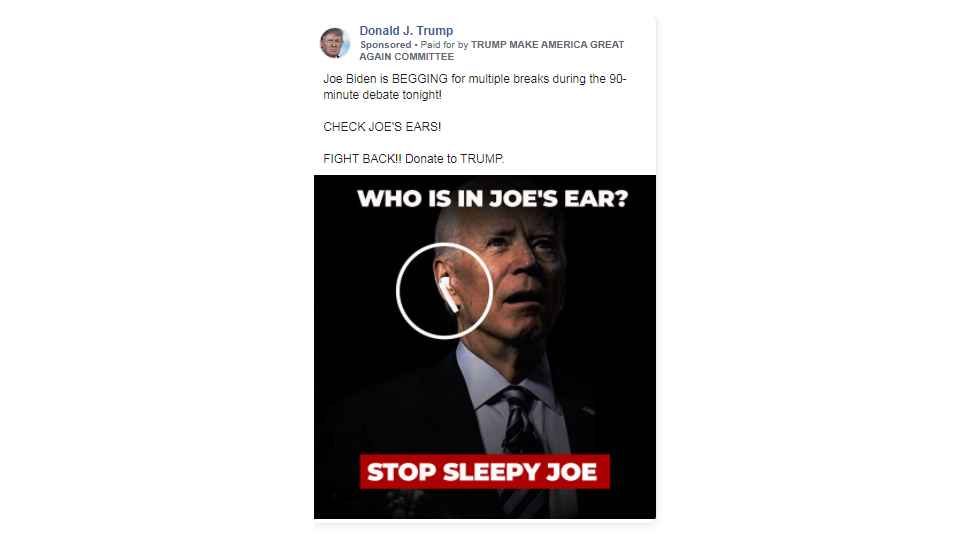
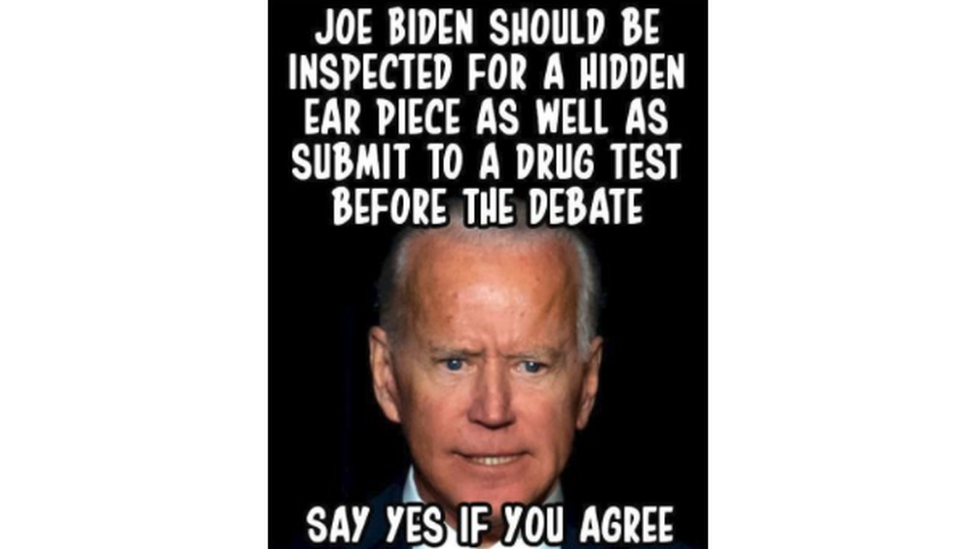
Ahead of Tuesday’s presidential debate, rumors began spreading among right-wing influencers and Trump campaign surrogates that Joseph R. Biden Jr., the Democratic nominee, was being outfitted with a hidden earpiece in order to receive surreptitious help during the debate, and that Mr. Biden’s campaign had refused a request from the Trump campaign to allow a third party to inspect both candidates’ ears for hidden earpiece receivers before the debate.

“If Joe Biden isn’t hiding anything,” wrote the conservative activist Charlie Kirk on Twitter, “why won’t he consent to a third party checking for an earpiece before tonight’s debate?”

The debate, of course, has not yet begun, and there is no evidence that Mr. Biden will be assisted by an earpiece once it does. (A member of Mr. Biden’s campaign staff called the rumor “completely absurd” during a call with reporters on Tuesday.) But the theory is being speculated about in right-wing media, including on Fox News, and it has been shared thousands of times on Facebook. It was also advanced by “Q,” the pseudonymous poster behind the QAnon conspiracy theory.

“Secret earpiece” rumors are nothing new. In fact, they’ve become something of a fixture during presidential debate cycles, and part of a baseless conspiracy theory that tends to rear its head every four years.

The first real earpiece conspiracy theory dates to 2000, when Rush Limbaugh, the right-wing radio host, accused then-candidate Al Gore of getting answers fed to him through an earpiece during a “Meet the Press” appearance. (A representative from the show confirmed to Slate that all guests wear earpieces in order to hear the audio tracks of news clips played during the show, but there is no evidence Mr. Gore was fed any answers.)

Four years later, during the 2004 presidential debates, rumors circulated among left-wing bloggers that George W. Bush was getting help from a surreptitiously placed earpiece.

Sign up for On Politics to get the latest election and politics news and insights.

“This theory goes a long ways toward explaining the president’s consistently odd speech patterns,” wrote the liberal blogger Joseph Cannon.

Commentators on the left speculated about a “bulge” in Mr. Bush’s jacket, which they imagined concealed a hidden receiver into which Karl Rove, the former president’s political adviser, was speaking. The Bush campaign tried to bat down the rumors, but they persisted, even though no solid evidence ever surfaced. A NASA scientist even got involved in analyzing images of Mr. Bush’s jacket during the debate, looking for clues about the mysterious bulge.

In 2008, rumors again circulated online that a candidate was being fed answers during a debate. Ann Althouse, a law professor and conservative blogger, wrote that close-up TV stills showed that Barack Obama “was wearing an earpiece” during a debate with John McCain. (Ms. Althouse later recanted her theory, saying it was probably just light reflecting off Mr. Obama’s ear.)

In 2016, the rumor appeared again, this time attached to Hillary Clinton, who was accused by right-wing websites of wearing a secret earpiece. (One such story, which appeared on the conspiracy theory website Infowars, was shared by Donald Trump Jr. and other pro-Trump influencers.)

The secret earpiece rumor is not exclusively an American phenomenon. Foreign politicians, including Emmanuel Macron of France, have also been baselessly accused of wearing earpieces during debates.

Accusing the opposing party’s candidate of wearing a secret earpiece is not a particularly sophisticated disinformation tactic, nor would it probably provide much help to a candidate even if it were true. (In fact, as anyone who has ever watched a live TV anchor fumble with a producer’s instructions could tell you, listening to directions in an earpiece while staying attentive to a moderator’s onstage questions requires a fairly impressive act of multitasking.)

But the idea of a hidden helper giving one side an unfair debate advantage has proved seductive to campaign operatives trying to explain away a lopsided debate, or sow doubts about cheating on the other side. As a 2016 Salon piece about the earpiece conspiracy theory said, these rumors mainly seem to appeal to hyperpartisans whose views on the candidates are already made up.

“When someone presents you with grainy screen captures of George W. Bush or Hillary Clinton and claims that they show telecommunications equipment hidden on their bodies,” the piece said, “your partisanship enables you to bridge the sizable gap between the poor evidence and the firm conclusion that someone offstage was whispering into the candidate’s ear.”


Source link

US squeezes China’s biggest chip-maker SMIC

0

[ad_1]

By Leo Kelion
Technology desk editor

SMIC

image copyrightSMIC/Getty Images

The US Department of Commerce has written to American suppliers of China’s biggest chip manufacturer, warning them of “unprecedented risks” that their products could be used by the Chinese military.

The letter reminds the firms they must apply for licences to ship controlled items to Shanghai-based SMIC.

But it does not appear that Washington has decided whether or not to add the firm to a trade blacklist.

SMIC has denied any military links.

And it said it had not received any formal notice of new restrictions from the US.

But the latest action caused Semiconductor Manufacturing International Corporation’s shares to drop about 7% in Hong Kong trade.

The fall followed a steeper decline earlier this month when the Pentagon first revealed it had proposed tougher restrictions against the business, including adding it to the government’s Entity List.

That would prevent any company selling goods or services to SMIC that involved US intellectual property without first getting special permission.

Such a step has already been taken against SMIC’s biggest client – Huawei – which has caused major disruption to the telecoms kit-maker’s business.

Chinese state media had previously reported that SMIC was among many companies that had

requested a US licence to continue supplying Huawei.

But one industry analyst suggested the latest move indicated the US was increasingly focused on SMIC itself.

“Denial of US semiconductor manufacturing equipment would put SMIC at a severe disadvantage, because most of that technology comes from American sources,” explained Jim Tully.

“China could aim to become self-sufficient in these technologies over the longer term, but it seems to me that it would take 10-plus years to do so.

“And in the short term, the equipment and related software SMIC already uses still needs ongoing support and maintenance from its producers.”

This has led to speculation that SMIC’s survival may now be at stake.

Blocked sale

SMIC was founded in 2000, and has since become the most prominent chip-making foundry in mainland China.

Until recently, it was viewed as being a beneficiary of rising US-China tension because it was expected to benefit from Beijing’s drive to make the country’s tech sector self-sufficient.

The firm has raised close to $10bn (£7.7bn) this year via a share sale and other means to expand its operations.

In addition to Huawei, SMIC’s clients include lesser-known Chinese chip designers including Gigadevice and Unisoc, as well as international companies including Qualcomm and Broadcom.

However, its most advanced products are said to lag two generations behind what rival manufacturers – including Taiwan Semiconductor Manufacturing Company (TSMC) and South Korea’s Samsung – are capable of, because SMIC cannot currently make transistors as small as they can. This means its products are not suitable to be the state-of-the-art processors in the latest smartphones or other advanced gadgets.

The reason for this is in part due to existing restrictions Washington has imposed on the firm.

At present, the only way to make the most advanced logic chips is to use equipment made by a Dutch company, ASML.

image copyrightGetty Images
image captionASML is the largest supplier of lithography semiconductor manufacturing machines
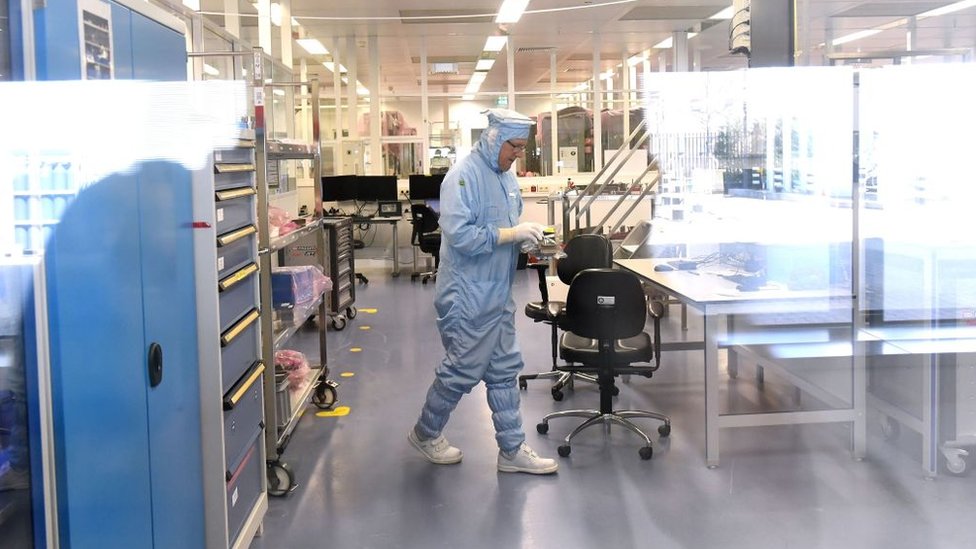
SMIC ordered a $150m lithography machine – which uses lasers focused by giant mirrors to print miniscule patterns on silicon – from ASML in 2018. But Reuters reported the White House convinced the Dutch government to block the export on security grounds.

A spokesman for ASML declined to comment when asked by the BBC whether the deal was still in limbo.

Adding SMIC to the US Entity List would prevent the Chinese firm sourcing hardware, software and chemical materials from other suppliers.

For now, the company is hoping to avoid that outcome by clearly denying it supplies products to the People’s Liberation Army.

“Any assumption of the company’s ties with the Chinese military are untrue statements and false accusations,” it has said.

But this has been called into question by others.

One Chinese state-owned newspaper has claimed the case illustrates the need for a “new long march” in order to “control all research and production chains of the semiconductor industry”.
Bloomberg has reported that Beijing plans to unveil new policies to support the sector in October.

More on this story

[ad_2]

Source link

NHS Covid-19 app: 10m downloads – and lots of questions

0

[ad_1]

By Rory Cellan-Jones & Zoe Kleinman
Technology reporters

Related Topics

  • Coronavirus pandemic

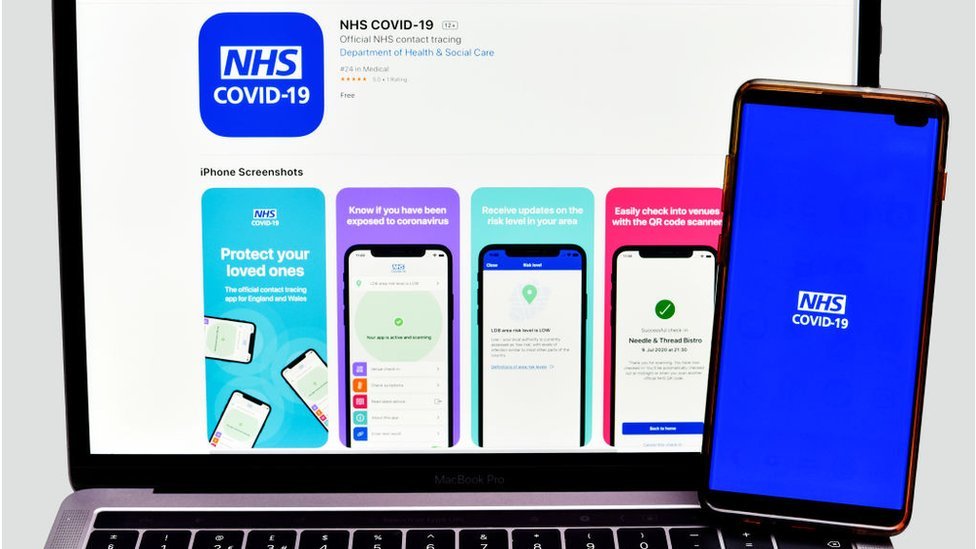
App on laptop and phone

image copyrightGetty Images

The government says more than 10 million people across England and Wales have downloaded the NHS Covid-19 app since its launch on 24 September.

The Department for Health and Social Care has emphasised that using it is voluntary.

It also says the guidance the app issues about whether to self-isolate or get a test is not enforceable by law.

The app itself may look simple, but it has thrown up lots of questions about how it works and what its limits are.

Here’s our attempt to answer some of your queries:

Why can’t I log out of a location after I’ve logged in?

A feature of the app is its ability to scan a QR barcode to log in at a pub, restaurant or other location – an alternative to actually handing over your contact details to that business on a paper log or website (though in Wales you still need to do both).

image captionRestaurants and other leisure facilities are supposed to display a unique QR code at the entrance to each of their properties

But people have noticed that while you can log in you cannot log out, and even if you soon leave the app thinks you are still there until midnight unless you log in somewhere else.

The point however of the QR scan is just to register your presence at that location rather than your proximity to someone infectious, which is registered via the Bluetooth contact-tracing feature.

If the location is later identified as a virus hotspot then an alert may be sent out to anyone who scanned a QR code there – not to self-isolate, but to be on the lookout for any symptoms of the virus.

But you cannot be alerted that somebody arrived in the pub hours after you left, and they later tested positive, because your phones could not have been physically close to each other at the same time.

Why can’t I input a negative test result?

On Friday it emerged that some test results were arriving without the code needed to register them in the app. By Saturday evening the Department of Health said

codes would now be provided with all positive test results, via a phone call from the contact tracing team.

image copyrightGetty Images

But some are asking why there isn’t a code for a negative result, especially as a self-isolation countdown begins as soon as someone registers that they have symptoms.

There seem to be a couple of answers. If you’ve been told to self-isolate because you have been in contact with an infected person, then you are supposed to do so regardless of whether you test negative yourself.

If you are the potentially infected person, then nobody will be notified via the app without a positive result. However, it does mean you have to live with the timer as it cannot be de-activated – but as we said, adhering to this is not legally enforceable.

Then there’s the fact that the intention is that you now arrange your test via the app after reporting symptoms. In this case, the results – positive, negative or void, (which means a retest is needed) – will be registered automatically in the app without any need to enter a code.

Why doesn’t the location change when I move around?

When you first download the app it asks for part of your postcode. You then get a message on the homescreen telling you what the risk level in your area is.

Why doesn’t this change when you move somewhere – for instance when a student leaves home to go to university?

Right at the beginning of the app’s development, privacy campaigners expressed concern about the government tracking people – and a promise was made that location tracking would not be a feature of this app.

There is however a way of changing that postcode without reinstalling the app. Go to “About this app”, then “Manage my data” and you will then be able to edit your postcode.

image copyrightNHS

Why doesn’t it work on my phone?

A number of people – in particular those with iPhones earlier than the 6S which went on sale in 2015 – are finding that they are unable to install the app on their phone.

This is not due to a decision by the app’s developers but is a limitation imposed by Apple and Google. They have designed the toolkit on which this and many other contact-tracing apps around the world are based – and they have determined that older phones would not be suitable for running the technology behind the app.

I get notifications which then disappear – what’s going on?

A number of people have reported getting notifications about exposure to the virus and then not being able to find out what they need to do next.

Some are confused because of the way they are written – including the phrase “exposure date, duration and signal strength have been saved”.

It appears that this again may be connected to the Apple-Google system, which sometimes sends out what are called exposure notifications. Here’s what the FAQ from the app team says about this issue:

“These are default messages from Apple and Google. There is no need to be concerned if you miss or overlook them, they are just visible to remind you that the functionality is on and working. You’re currently not able to turn off these default Apple and Google notifications.

“Important messages from the NHS Covid-19 app will always be visible to you from inside the app.”

Like other apps, NHS Covid-19 will get updates and new features. And the NHS is inviting people to send in any feedback about problems they have faced or features which could improve the app.

Related Topics

[ad_2]

Source link

TikTok: US judge halts app store ban

0

[ad_1]

TikTok

image copyrightReuters/TikTok

A US judge has issued a temporary injunction preventing a ban on future downloads of the TikTok app.

The app had faced being blocked from Apple’s App Store and Android’s Google Play marketplace from 23:59 Eastern time.

Existing US-based users would have been able to continue using it.

But they would not have been able to re-download the app if they deleted it from their phones, nor have been offered software updates.

Judge Carl Nichols of the US District Court for the District of Columbia issued a temporary injunction on Sunday evening at the request of TikTok.

The opinion was sealed, meaning that no reason for the decision was released.

  • TikTok: Oracle confirms being picked by Bytedance to be app’s partner

  • TikTok and WeChat: US to ban app downloads in 48 hours
  • TikTok: What TikTokers make of Trump’s ban threat

TikTok had argued that forcing it off the iOS and Android app stores would have violated the First and Fifth Amendments of the US constitution.

It claimed that preventing some users joining the app unlawfully impinged upon their freedom of speech and that the firm’s own right to due process would have been breached by not giving it a proper opportunity to defend itself first.

“How does it make sense to impose this app store ban tonight when there are negotiations underway that might make it unnecessary?” added a member of the app’s legal team.

The US government’s lawyers in turn had described the app’s parent as being “a mouthpiece” for the Chinese Communist Party (CCP).

The ruling comes one week after another Chinese app – WeChat – that also faced a ban, was given its own last minute reprieve by the US courts.

National security

The long-term fate of TikTok in the US is still unclear. At present it is owned by a Chinese company, Bytedance, but operated as a separate entity to Douyin – a parallel version used by Chinese consumers.

The Trump administration has claimed Bytedance’s involvement poses a unacceptable national security threat, because it would have to comply with an order to support the CCP’s “malicious collection of American citizens’ personal data”.

Bytedance denies this, saying that TikTok’s user data is kept in the US and Singapore, and so is not subject to Chinese law.
Even so, after being threatened with a ban, a week ago TikTok said that it had agreed a deal to let database company Oracle and retail giant Walmart take up to a 20% stake in a new spun-off entity called TikTok Global ahead of shares in the endeavour being floated.
But President Trump subsequently said he would not accept any arrangement that did not involve Bytedance ceding control to the two US firms.

image captionTikTok’s audience skews younger than that of Facebook, YouTube and Twitter

To further complicate matters, Beijing has yet to announce whether it will grant Bytedance a licence to include TikTok’s algorithms in any deal.

Algorithms power the app’s recommendation engine, deciding which videos to show to each user, based on the ways they have previously interacted with the product.

The algorithms are highly responsive to each person’s interests, quickly picking up on shifts in behaviour, and are credited with helping make the app so popular.

If China refused to let them be included in a deal, it could scupper any sell-off.

‘Critical growth’

TikTok has said it has more than 100 million active users in the US and about 700 million worldwide.

It has claimed even a temporary ban would threaten its business.

“[A] ban will cause our user base to stagnate and then precipitously decline,” wrote interim boss Vanessa Pappas in a court filing.

“For TikTok to remain competitive, continued growth at this stage in our development is critical.”

The US government has issued two executive orders targeting TikTok. While the first is designed to prevent it being distributed via Apple and Google, the second is more far-reaching.

Due to come into force on 12 November, it is designed to shut the app down outright in the US, if the president’s national security concerns are not resolved.

TikTok Timeline

image copyrightEPA

March 2012: Bytedance is established in China and launches Neihan Duanzi – an app to help Chinese users share memes

September 2016: Bytedance launches the short-form video app Douyin in China

August 2017: An international version of Douyin is launched under the brand TikTok in some parts of the world, but not the US at this time

November 2017: Bytedance buys lip-synch music app Musical.ly

May 2018: TikTok declared world’s most downloaded non-game iOS app over first three months of the year, by market research firm Sensor Tower

August 2018: Bytedance announces it is shutting down Musical.ly and is moving users over to TikTok

February 2019: TikTok fined in US over Musical.ly’s handling of under-13s’ data

October 2019: Facebook’s Mark Zuckerberg publicly criticises TikTok, accusing it of censoring protests

November 2019: The Committee on Foreign Investment in the United States opens a national security investigation into TikTok

May 2020: TikTok hires Disney executive Kevin Meyer to become the division’s chief executive and chief operating officer of Bytedance

June 2020: India bans TikTok among dozens of other Chinese apps

July 2020: US Secretary of State Mike Pompeo, and then President Trump, say TikTok might be banned

August 2020: Microsoft and Oracle make rival approaches to acquire or otherwise operate TikTok in the US and three other markets. Mr Meyer announces he is leaving the company because the “political environment has sharply changed”

September 2020: TikTok rejects Microsoft’s bid, paving way for Oracle and Walmart to clinch a deal. The US Department of Commerce gives a one-week extension to its original app-store-ban deadline, but there is still confusion over the terms of the arrangement as the time limit approaches

Related Topics

  • TikTok

  • China
  • United States
  • Apps

[ad_2]

Source link

NHS Covid-19: App users unable to input negative tests

0

[ad_1]

By Zoe Kleinman
Technology reporter

Related Topics

  • Coronavirus pandemic

NHS Covid-10 app

People who test negative for Covid-19 are unable to share the result with the new NHS app for England and Wales if they did not book the test through the app in the first place.

The app asks for a code to register a test result but a code is only received if the test is positive.

Those who enter that they have symptoms without entering a result find a self-isolation countdown begins.

The Department for Health and Social Care said the app would be updated.

People who have been using the app since its launch on Thursday, and who had already booked tests before downloading it, have found that they are unable to stop the self-isolation countdown after reporting symptoms if they then get a negative result, because it does not come with a code they can share.

“That’s so confusing as the app doesn’t tell you that can’t enter negative test booked outside it,” said Prof Deborah Ryan, who originally contacted the BBC.

“And the app still tells you to quarantine if you entered symptoms. So this means I can’t turn off the self-isolation alert in the app?”

The self-isolation alert cannot be de-activated in this situation.

In addition, tests taken as a result of the Office for National Statistics surveys, and those taken in an NHS Hospital or Public Health England lab, cannot be shared on the app regardless of the result,

according to a tweet from the app’s official account.

It is not clear how many test results would be affected by this.

The Department of Health said that using the app is “entirely voluntary” and advice to get a test or self-isolate cannot be enforced.

Tests booked via the app will have the results automatically shared with it, it said.

According to the data analyst App Annie the NHS Covid-19 app has been downloaded around 4m times so far.

“By downloading this app you are helping protect yourself and others. If you book your test via the app then the results will be automatically recorded in the app and the isolation countdown will be updated,” said a DHSC spokesman.

Related Topics


[ad_2]

Source link

Taio Cruz quits TikTok after ‘suicidal thoughts’

0

[ad_1]

Taio Cruz

Image caption

Taio Cruz was only on TikTok for a matter of days before deleting his account.

Pop star Taio Cruz has opened up about his reasons for quitting TikTok, saying he wanted to preserve his mental health after having “suicidal thoughts”.

The musician, whose hits include Dynamite and Break Your Heart, said he had been targeted by “hateful” videos and comments on the video-sharing app.

“My body was shaking and I had suicidal thoughts,” he explained on Instagram.

“I pride myself on being mentally resilient so the fact that I felt that way, shocked even me.”

The 35-year-old added: “Some users posted hateful, mocking videos which spurred a feedback loop of negativity, where more and more people began to join in on the mockery and hate.

“My intention was to make some fun videos and interact with my fans, but some, whom I won’t mention, were averse to that.

“For my own mental health, I would rather be where I’m welcomed, for now, TikTok is not that place. Social media shouldn’t be like this, sadly it is.”

The London-born singer rose to fame in the late 2000s, scoring two number one singles in the UK, and writing for artists including Jennifer Lopez, Usher and David Guetta.

He joined TikTok earlier this week and quickly gained 85,000 followers – but abruptly deleted all his videos on Wednesday, posting a message that read: “Never in my life have I had a more negative experience than the past few days on here”.

“This community is not for me,” he added.

The BBC understands that the musician was targeted by messages accusing of him of being irrelevant and “begging for clout”.

One user who wrote, “I just saw one of his videos [and] scrolled so fast,” received a response from the star – who simply posted the shrug emoji.

The majority of the comments were posted beneath Cruz’s own videos, which are no longer available.

After the musician deactivated his account, fans sent him messages of support on social media.

“Your music has made me smile from when I was five,” wrote one Instagram user. “I’m so sorry, please remember how strong you are.”

“We love you and we’re looking forward to hearing more songs from you. You are an absolute legend,” added another.

TikTok star Dixie D’Amelio, who has 38 million followers on the platform, also expressed her concern.

“This makes me so sad,” she wrote on Twitter. “Y’all bullied a legit music artist off TikTok in under a week… WHAT??? Just be nice.”

In a statement provided to the BBC, a TikTok spokesperson said: “We’re a huge fan of Taio and are extremely disappointed he has experienced negativity from a limited number of users.

“TikTok is a safe space for our community and we have a zero tolerance approach to bullying and harassment.

“We are in discussions with Taio’s management and this matter is under investigation with our Trust and Safety Team.”

Follow us on Facebook, or on Twitter @BBCNewsEnts. If you have a story suggestion email


[ad_2]

Source link

The State Duma proposed to tighten the rules for registering children in social networks

0

State Duma Deputy Yevgeny Fedorov sent a letter to the head of the Ministry of Digital Development Maksut Shadayev, in which he proposed registering children under 14 on social networks only with the permission of parents or other legal representatives. It is reported by RT on Friday, September 25.

“I ask you, together with the social networks represented in the Russian Federation, to consider the possibility of introducing a legal mechanism for verifying registered users, as well as registering children under the age of 14 only with the permission of their legal representatives,” the letter says.

Fedorov noted that at present, any child can, without any obstacles, create his own personal account on social networks, which are a tool for potential offenders to incite youth to commit illegal actions, including organizing unauthorized actions and mass street riots.

Due to their age, the deputy noted, children are easily influenced by various destructive ideas.

Earlier, on September 1, Izvestia wrote that the majority of parents in Russia use parental control in order to protect their children from inappropriate content, and not to control their hobbies.

According to the survey, the main threats to children on the Internet are considered by parents to be content related to violence and cruelty, communication with strangers and dangerous groups on social networks.

NHS Covid-19 app: England and Wales get smartphone contact tracing for over-16s

0

[ad_1]

By Leo Kelion & Rory Cellan-Jones
Technology reporters

Related Topics

  • Coronavirus pandemic

NHS Covid-10 app

image captionUsers will be told to self-isolate if the app determines they are at high risk of being infected

People living in England and Wales are being urged to download the government’s official contact-tracing app following its official release.

NHS Covid-19 instructs users to self-isolate for 14 days if it detects they were nearby someone who has the virus.

It also has a check-in scanner to alert owners if a venue they have visited is found to be an outbreak hotspot.

Anyone over the age of 16 is being asked to install the app onto their smartphone.

That is a change from trials, which were limited to the over-18s.

The move reflects a desire by health chiefs for the software to be used by as many students in further education colleges and universities as possible.

The age limit is in line with the Protect Scotland contact-tracing app. And health chiefs behind Northern Ireland’s StopCOVID NI have said they intend to launch a new version that accepts under-18s later this month.

image copyrightDepartment of Health

image captionUser will have to verify they are over 16 before they can start using the app

Health Secretary Matt Hancock said that with coronavirus infection rates rising, the app could help keep people safe.

“I urge everyone who can to download and use the app to protect themselves and their loved ones,” he said.

The government had originally intended to release the app months ago. But problems with the initial design and the addition of extra features meant it was only ready for its final public test in August.

One tech expert who has tracked the initiative acknowledged the team involved had worked hard to address concerns about privacy and transparency, but said wider problems could still limit its impact.

“Not only is the app late to launch, but it will be hindered by the delays in the testing system,” Rachel Coldicutt told the BBC.

“If you don’t have symptoms, will a push notification saying you were near someone a week ago make you and your family self-isolate and spend days hitting refresh on the testing website, trying to find a test?”

Although the app allows users to order a coronavirus test and automatically get the results, the government does not believe it will complicate efforts to meet demand.

How can people access the app?

The app is available for smartphones only – not tablets, smartwatches or other devices.

To get started, go to

Android’s Google Play or Apple’s App Store and search for “NHS Covid-19”.

The handsets must have Android 6.0 (released in 2015) or iOS 13.5 (released in May 2020) and Bluetooth 4.0 or higher.

And some of the latest Huawei handsets are excluded.

What will contact-tracing alerts say?

The notification will tell the recipient to go into self-isolation for a fortnight – and trigger the start of the app’s countdown clock.

Even if the recipient has no symptoms or a subsequent negative test result, they must stay at home for the duration.

Unlike when a human contact tracer orders someone to self-isolate, the app keeps the subject’s identity a secret.

Those that have not received such an alert, but fill in the app’s symptoms checker and meet the criteria, will be directed to self-isolate for eight days and be directed to an external website to book a test.

Automated contact tracing is designed to complement the work done by humans by helping to identify encounters with strangers – for example, someone standing close to a user while waiting in a queue outside a shop.

When someone anonymously shares a positive Covid-19 test result via the app, a process developed by Apple and Google makes other users’ smartphones check if they had recently detected the infected person’s handset.

But smartphones were not designed for this purpose and the readings involved are not always accurate. This has led to fears of “false positives” – people being instructed to self-isolate who were never at risk.

image copyrightDepartment of Health
image captionA publicity campaign will encourage users to download the app to protect others

However, health chiefs believe a recent change to the calculations involved should help minimise the problem: they now take into account when the virus-carrier was at their most contagious.

The Department of Health has confirmed that users who ignore the app’s self-isolation warning are in theory liable for fines of £1,000 or more.

However, because they do not have to identify themselves, officials acknowledge this will normally be impossible to enforce.

Barcode check-ins

One of the app’s other major features is a scanner to let it keep track of pubs, restaurants, hairdressers and other places the user has visited.

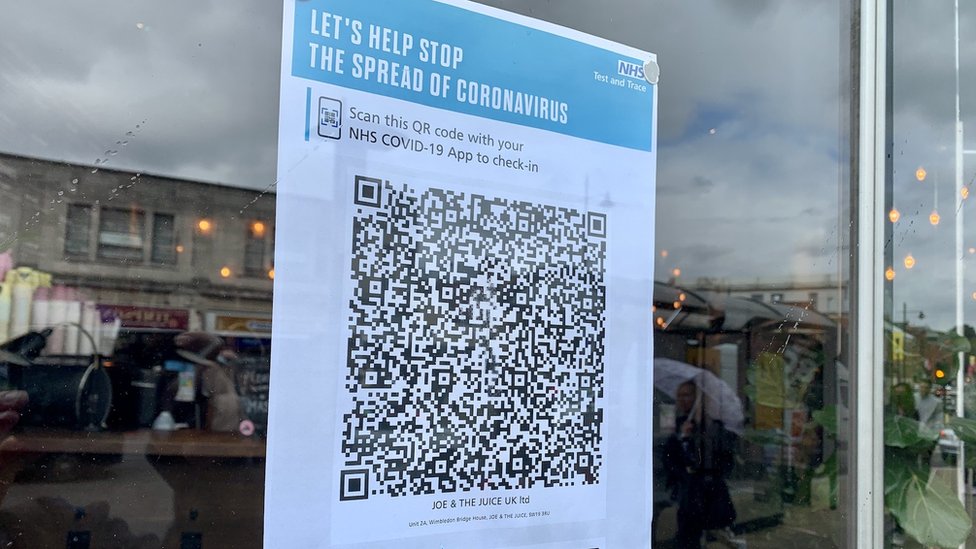
Hospitality venues in England now face £1,000 fines if they do not display an official Test and Trace poster featuring a QR barcode assigned to them.
image copyrightDepartment of Health
image captionCinemas, community centres and places of worship are also being asked to display authorised QR barcode posters

So far, the government says more than 160,000 businesses have downloaded a unique code for their property.

The benefit is that if officials later identify a venue as being at the centre of an outbreak, they can update a database which the phones regularly check for a match.

Users can then be told to self-isolate and/or get tested, depending on the circumstances, without having to revealing their identities.

Free data

Other facilities, including postcode-based threat updates and details of the latest guidance, are intended to encourage people to regularly look at the app and change their behaviour.

But a major challenge will be convincing them to download it in the first place:

  • officials suggest only about one in 10 people installed the app during a recent trial in the London Borough of Newham, an area picked for its ethnic diversity. When the BBC visited on Wednesday, a reporter could only find one person using it
  • Scotland’s app launched about a fortnight ago, and roughly one in five people there have installed it
  • Ireland, one of the leaders in the field, has still only convinced about one in three people to use its app, which was released in July

To encourage adoption in England and Wales, the the major mobile networks have agreed not to deduct data used by the app from subscribers’ monthly allowances.

In addition, the app now supports more languages than the test version – adding Turkish, Arabic, Mandarin, Romanian and soon Polish.

image captionThe app provides a risk score for the user’s neighbourhood as well as a self-isolation countdown clock

And it now allows users to delete individual venue visits from the app’s “digital diary”. This followed feedback from victims of domestic abuse, whose partners often check their phones.

One change, however, may be less popular.

Those told to go into self-isolation because of a contact-tracing match will not be able to challenge the decision.

A document published last month had indicated that users would be able to call an NHS 111 operator, who might overrule the command.

Related Topics

[ad_2]

Source link

NHS Covid-19 app: How England and Wales’ contact-tracing service works

0

[ad_1]

By Leo Kelion and Rory Cellan-Jones
Technology reporters

NHS Covid-19 app

It has been a long time coming but England and Wales’ Covid-19 app will launch on Thursday.

It follows in the footsteps of Scotland and Northern Ireland’s own efforts but has more features.

Apple and Google’s automated contact-tracing technology will be used to tell people to self-isolate if their phone detects they were near someone later determined to have the virus.

But there’s more, including:

  • a venue check-in barcode scanner
  • a postcode-based risk-level checker
  • a symptoms-reporter tool
  • the means to order a coronavirus test and receive its results
  • a countdown timer to keep track of how long to stay in self-isolation
  • a guide to the latest advice on local restrictions, financial support and other related information

image copyrightDepartment of Health

image captionThe app keeps a record of venues the user has been to in order to warn them if one is later linked to an outbreak

So while contact-tracing may seem like the headline feature, health chiefs say the primary goal is to change people’s behaviour to make them less likely to catch or transmit the coronavirus.

How can people access the app?

The app is available for smartphones only – not tablets, smartwatches or other devices.

To get started, go to Android’s Google Play or Apple’s App Store and search for “NHS Covid-19”.

The handsets must have Android 6.0 (released in 2015) or iOS 13.5 (released in May 2020) and Bluetooth 4.0 or higher.

image captionThe app first asks the user for permission to use Bluetooth and their postcode, before revealing its home screen

And some of the latest Huawei handsets are excluded.

How will it send contact-tracing alerts?

When two devices running the app are close to each other, they exchange Bluetooth “handshakes” to determine the distance and duration, measured in sessions lasting five minutes.

The measurements are not always accurate – and work continues to improve them – but the logs are used to create a cumulative points score for the set of interactions between two people over the course of a day.

The formula may be tweaked over time.

If the points threshold is met and one of the two owners later shares a positive coronavirus test via the app, then the other will receive an alert.

What will this alert say?

The notification will tell the recipient to go into self-isolation for a fortnight – and trigger the start of the app’s countdown clock.

But the recipient is not told who triggered the alert.

And the authorities cannot identify either party, although they can track how many people have been told to self-isolate.

Even if the recipient has no symptoms or a subsequent negative test result, they must stay at home for the duration.

  • How does Covid-19 test-and-trace work?

Can users be fined if they ignore a self-isolate alert?

From 28 September, people in England can be fined £1,000 or more for breaching self-isolation rules.

But because the app lets users remain anonymous and health chiefs want it to be popular, fines for users should not be an issue.

Unlike when a human contact tracer orders someone to self-isolate, the app keeps the subject’s identity a secret.

Only if they subsequently get in contact – for example to arrange a financial support payment – will their name be registered.

How will the venue check-in process work?

Restaurants, bars and other leisure facilities should display an authorised QR barcode on a poster or digital sign, which the app can scan.

image captionThe app recognises only QR codes related to the check-in scheme, to which businesses must be registered

The venue will then be added to the app’s “digital diary” of places the user has visited.

And the user will not need to give their name and address to the venue.

If officials later judge the location to be the centre of an outbreak, they can trigger an alert to users who were there.

And this notification might tell them to use the app’s symptoms checker and/or self-isolate.

How will the postcode facility work?

When a smartphone owner first uses the app, they are given the option of typing in the first part of their postcode – “M23”, for example.

Typically, thousands of other households will have the same code, so although this causes information to be shared with the authorities, it should not identify individuals.

image captionThe app can trigger notification alerts to warn the user if their local risk level has changed or if they have been linked to someone who has the coronavirus

The user is then given a risk-level for their neighbourhood, at the top of the app’s home screen, and can be sent an alert if it changes.

And in turn, the NHS and local government can collect data about the numbers of app downloads and coronavirus cases in their area, helping them manage the crisis.

How will the app order a test?

Users can report symptoms – and when they started – at any time.

If they suggest infection, the user is told to book a test and that everyone in their household must self-isolate for eight days.

Booking a test involves using an external website, which asks for the user’s name and address.

But these personal details are not shared back to the app.

And a unique code lets users receive their test result via the app as soon as it is ready.

Will the app drain the battery and data allowance?

The developers suggest the app should account for less than 5% of a device’s battery use.

But if the phone is set to use a low-power mode, owners should go into their settings to exclude the app so it can continue contact tracing at all times.

And while the app is continually checking for updated data, it should not have a significant impact on people’s allowances.

What if users travel to Scotland or Northern Ireland, which have their own apps?

Apple and Google’s framework will not allow two apps to contact trace simultaneously.

So when users cross the border, they need to open the local app and turn on contact tracing within it.

This will bring up a prompt asking: “Switch app for exposure notifications?”

image captionGoogle Play shows users which UK-related contact-tracing apps are available to them

Doing so, will turn off the one they were using beforehand.

What if users work with PPE or behind a perspex screen?

While users are normally encouraged to keep the app active and their phone to hand whenever out of the house, there are exceptions.

To avoid people being told to self-isolate when they were protected, or phones logging each other while in lockers, there is an option to temporarily turn off contact tracing, at the bottom of the home screen.

How will the app tie into other efforts?

While the human and automated contact-tracing systems are being deliberately kept separate, they should complement each other.

So, for example, if you were in a supermarket queue, human tracers might find it hard to identify the person next in line but the app would be able to.

Likewise, if you were at a pub where a contagious user was sitting but not using the app, you might still receive an alert via the check-in service.

Will it make any difference?

According to modelling done by the University of Oxford, the app can significantly reduce deaths and hospital admissions if at least 15% of the population use it.

But real-world data on how effective such apps have been in other countries using them is scant.

And so far, they have been offered when the levels of infection have been relatively low, meaning the chance of any user receiving an alert has been slim.

Most people have yet to be convinced to install them too – about a third of the population in Ireland, 22% in Germany and only about 4% in France have done so.

As Covid-19 resurges that may change.

And as health chiefs note, there are other measures of success, including whether those that do download the app regularly open it and then change their behaviour as a result.

Related Topics

  • Contact tracing

  • Coronavirus testing
  • Apps

[ad_2]

Source link