The redeployment of US military forces in Europe aims to strengthen the containment of Russia. This was announced on Wednesday, August 12, by the deputy chief of the Joint Chief of Staff of the United States Armed Forces, General John Hayten, reports RT.
According to the senior military, Washington is moving forces, including back to the United States, to strengthen their training and deploy them again in Europe on a rotational basis.
“Poland is a more active partner, Romania is a more active partner, the Black Sea region is more active because this is where we are strengthening our deterrence against Russia, which is the number one priority of the Minister of Defense,” Haiten said in an online discussion hosted by the Hudson Institute. in Washington.
After the redeployment, he noted, the largest contingent of US troops will remain in Germany and added that it is important to look at NATO through the prism of 2020, not 1991.
On August 9, the head of the Pentagon, Mark Esper, also announced that the United States was regrouping its forces in Europe in order to advance to the borders of Russia. According to him, Washington intends to strengthen the “containment” of the Russian Federation and therefore is increasing its military presence at the Russian borders. It was for this purpose that American leader Donald Trump decided to redeploy part of the military from Germany to other European countries.
On the same day, the head of the Federation Council Committee on International Affairs, Konstantin Kosachev, said that the build-up of the US military presence in Europe entails a degradation in the security sphere on the continent. The senator stressed that the responsibility for this situation lies solely with the United States and those European countries that allow the strengthening of the American military contingent on their territories.
Three Bedrooms Inside a Converted Industrial Space
$1.95 MILLION (1.495 MILLION BRITISH POUNDS)
This three-bedroom home, converted over the past two years from an auto mechanic’s garage, is just down the street from Mile End Park in East London. The modern design incorporates below-ground and staggered levels to maximize the house’s 1,600 square feet of living space, with a central glass atrium that runs from top to bottom.
“It’s a clever design to bring light to the lower part of the building, so you don’t feel like you’re in a boat or something,” said Chloe Bliss, an agent with The Modern House, which has the listing.
The home’s brick facade is painted black, with sections of frosted glass above oak doors. The main entrance opens into the combined kitchen and dining area, which has a double-height ceiling, two skylights and polished concrete floors. The appliances and sink are built into the sleek cabinetry that runs the length of one wall.
An oak and black steel staircase leads up a half level to the living room, which has glass walls overlooking the kitchen on one end and the atrium on the other. It has a skylight, oak parquet floors and a linear frosted glass window to bring in more light. On the other side of the atrium is a bedroom (currently configured as an office) with an en suite bath. Stairs at the kitchen end of the living room lead to a small rooftop terrace.
The other two bedrooms, one with an en suite bath, are below the kitchen, situated on either side of a small courtyard at the base of the atrium. Another level below is a large “family bath” lined with polished concrete. It has a large walk-in shower, a trough sink and a soaking tub.
The property does not have a garden or dedicated parking space. There is a bike storage closet just inside the main entrance, Ms. Bliss said.
The once-industrial East London neighborhood has been undergoing regeneration for some time, Ms. Bliss said. This property is flanked by a builder’s supply shop on one side and homes undergoing redevelopment on the other. Two parks are within a block: The 79-acre Mile End Park, with its fitness center and stadium, climbing wall, skate park and children’s playground; and Tower Hamlets Cemetery Park, a restored Victorian cemetery. Shops for necessities and casual restaurants reflecting the area’s ethnic diversity are within an easy walk, she said.
The property is about a 10-minute walk to the Mile End underground station; the ride to central London is about 15 minutes. Heathrow Airport is about 75 minutes by car, and 90 minutes by public transit.
Market Overview
After at least five years of flat or falling prices, due in large part to the economic tumult unleashed by its protracted withdrawal from the European Union, Britain began to see some encouraging signs in the housing market as 2020 began.
“Over the past three years, there has been a general slowdown in UK house price growth, driven mainly by a slowdown in the south and east of England, but there has been a pick-up in annual growth since December 2019,” according to a March 2020 report by the Office for National Statistics.
The average house price across England in March was 248,000 British pounds ($323,000), a 2.2 percent rise from March 2019. In London, prices grew by 4.7 percent year over year to an average of 486,000 pounds ($635,000) —the largest 12-month growth in the capital region since December 2016.
According to the report, the increased growth in London “may reflect a larger shift in the type of properties being sold than usual, with more sales of very high value properties.”
The report also notes that the national House Price Index would be “suspended until further notice” due to data volatility caused by pandemic-related disruptions. But real estate agents there report that London’s housing market has seen a surge in demand since England’s pandemic-induced prohibition on in-person real estate showings was lifted on May 12.
“There are a few things going on,” said Tom Bill, head of United Kingdom Residential Research for the property firm Knight Frank. “We have a degree of pent-up demand that’s been building for five or six years against the landscape of Brexit, tighter lending conditions, and an ever-changing tax landscape. Then the general election last December that elected a majority government released a lot of demand in January and February.”
The subsequent coronavirus lockdown, he added, “caused people to re-examine how and where they live, and we are at a slightly artificial moment in time. We don’t know how long it’s going to go on.”
Britain has been hit hard by Covid-19, with 310,829 reported cases and 46,574 deaths as of Aug. 11, including the second-highest death rate in the world, according to the World Health Organization. While England has lately seen some local outbreaks, cases have been on enough of a decline that buyers are venturing out in large numbers.
“People are feeling a little more confident that they understand what is going on globally more than they did three months ago,” said Guy Gittins, managing director of the estate agency Chestertons. “They were more fearful and paranoid at the start of lockdown. And if you’re working at home, suddenly you need that home office or that garden.”
In the month leading up to Aug. 7, Chestertons’s 32 London offices had 100 percent more accepted offers than during the same period last year, Mr. Gittins said, adding that the fall-through rate on deals was half that of the previous year. “That is a very important indicator of buyer sentiment,” he said. “We haven’t seen a market like this for 10 years.”
Ms. Bliss said that visitors to The Modern House website have increased by 144 percent since May 13 compared with the same period last year. About 70 percent of those visitors were new to the site.
Leafier parts of London offering family houses with more outdoor space, including Wandsworth, Richmond, Dulwich and Islington, saw small price increases in July due to rising demand. Prices in prime central London, including the neighborhoods of Mayfair, Kensington and Notting Hill, remained flat, as those areas are more reliant on international buyers, many of whom have been stymied by travel complications, Mr. Bill said.
Who Buys in London
While interest from international buyers dropped off during the lockdown, there were some “brave buyers” who used the moment to strike some discounted deals from afar, Mr. Gittins said.
“We put together some high-value deals for overseas buyers who were very familiar with the city and the types of properties,” he said.
More recently, Chestertons’s offices have seen a doubling of interest from Hong Kong buyers, many looking for a safe haven from the political unrest at home, he said.
Interest from U.S. buyers has also increased over the last year or so, Ms. Bliss said. (Americans traveling to Britain are currently required to quarantine for 14 days.) Other foreign buyers tend to come from China and the Middle East.
Buying Basics
There are no restrictions on foreign buyers in England. Buyers and sellers use their own lawyers. The agent’s commission in London is 2 to 3 percent, and is paid by the seller.
Buyers must pay a surcharge of 3 percent of the purchase price if the property is a second home.
Foreign buyers should be aware that many apartments in the prime, older areas of central London are for sale on a leasehold basis, Mr. Gittins said, wherein purchasers buy a lease from the building owner, which could be an individual or group of individuals.
“You own it for a set period of time — it could be very, very short or very, very long — and you have the right to extend that lease,” he said. “There are rules around that, and it’s complicated, so you definitely need very good legal expertise to walk you through that.”
Websites
Languages and Currency
English; pound sterling (1 pound = $1.31)
Taxes and Fees
Normally, stamp-duty land tax is due on the portion of a sale price above 125,000 pounds ($147,000), starting at 2 percent and gradually rising to 12 percent on the portion above 1.5 million pounds ($1.77 million).
However, a tax “holiday” in place countrywide through March 31, 2021, exempts the first 500,000 pounds ($590,000) from the tax, and provides additional savings up to a maximum of 15,000 pounds ($17,700), Mr. Bill said.
“Up to purchases of $1.5 million, it does make a difference, and we’ve noticed a relative uptick in activity in that range,” he said.
Legal fees for a freehold purchase range from about 1,000 to 5,000 pounds ($1,180 to $5,900), Mr. Gittins said. Fees for a more complicated leasehold purchase could be twice as much.
Annual council taxes on this home are around 1,400 pounds ($1,650), Ms. Bliss said.
Contact
Chloe Bliss, The Modern House, 011-44-7508-133-248; www.themodernhouse.com
For weekly email updates on residential real estate news, sign up here. Follow us on Twitter: @nytrealestate.
Image caption
Dr Ruja Ignatova has been charged with wire fraud, security fraud and money laundering, by the US authorities
In June 2016, Dr Ruja Ignatova told an audience of thousands at Wembley Arena that her new cryptocurrency, OneCoin, was a “Bitcoin killer” and would make early investors rich. Many in the crowd had already poured in their life savings. Many more followed.
About £2bn from across the world was spent on OneCoin tokens, including tens of millions of pounds from British families.
Then, in late 2017, Ruja disappeared and the scheme was exposed to be a scam. There was no cryptocurrency. It was an old-fashioned Ponzi scheme.
For 18 months, I’ve investigated the scandal for BBC Sounds, for the podcast The Missing Cryptoqueen, alongside my producer, Georgia Catt.
After a break, we returned for a new episode last week, which focused in part on the UK’s Financial Conduct Authority.
Image copyright OneCoin
Image caption
Dr Ruja spoke at Wembley Arena in the summer of 2016
Just three and a bit months after the London extravaganza, the watchdog posted an online warning about the get-rich scheme, headlined: “Beware trading virtual currencies with OneCoin”.
It said consumers should be “wary of dealing with OneCoin” and the organisation was being investigated by the City of London Police.
“This firm is not authorised by us and we do not believe it is undertaking any activities that require our authorisation. However, we are concerned about the potential risks this firm poses to UK consumers,” it added.
This helped counteract the claims of OneCoin promoters, who were trying to pull in more victims.
And delighted critics would spend their evenings sending the FCA warning to potential new recruits.
But on or around 1 August 2017, with the scam in full momentum, the authority suddenly removed its notice.
Now, it was Ruja’s turn to be thrilled.
According to retired libel lawyer David Hooper, it should have been obvious to the regulator OneCoin’s promoters were going to use this “as a marketing opportunity”.
And OneCoin promoters quickly began claiming it meant the FCA no longer considered OneCoin a risk.
One triumphantly told his followers: “If [the FCA] still thought we were a fraudulent company… then, guess what, that warning’s not removed.”
While making the podcast, we’ve seen letters a UK law firm hired by Ruja sent to her critics.
The letters threatened legal action unless they deleted online posts claiming OneCoin was a pyramid scheme run by a criminal organisation.
And at some point, one of Ruja’s advisors – although it’s still not clear exactly who or when – realised the FCA might have overstepped its regulatory authority.
And, according to multiple sources, the law firm pressured the FCA to have the notice removed.
Heavily promoted
All regulators have their own turf to referee.
The FCA’s covers financial products and services.
What’s included isn’t always clear, especially with new products.
And being so novel, cryptocurrencies were, and still are, outside this “perimeter”.
In response to a query at the time of its removal, the FCA said it “had been on our website for a sufficient amount of time to make investors aware of our concerns”.
However, several alerts have remained live on the FCA’s website for years, even decades. Not to mention the scam was still being heavily promoted in the UK at the time.
When we asked again, it told us the initial decision to publish the notice had been at City of London Police’s request and the decision to take it down had been made “in conjunction” with the force.
“It did not appear that OneCoin was carrying on any activities that required FCA authorisation,” it said.
“The FCA does not regulate crypto-assets and therefore it could not take this matter further.
“Any queries should be directed to the City of London Police on this.”
We followed this up with the police force. But it made clear responsibility for the notice was the regulator’s alone.
“The City of London Police was made aware of the FCA’s intention to take down their alert on OneCoin and their reasons for doing so,” said a spokesman.
“The force accepted that the decision belonged to the FCA given that this was their alert.”
We went back to the FCA to ask again what its reasons were but it declined to comment further.
Image copyright FCA
Image caption
The FCA’s notice was deleted despite City of London Police continuing its investigation into OneCoin for years afterwards
City of London Police ultimately dropped its own investigation, citing “insufficient evidence to support criminal proceedings” but was thanked by US prosecutors for helping them convict a lawyer who had helped launder $400m (£300m) of OneCoin’s proceeds.
However, neither of these events happened until two years later, in 2019.
And critics believe once the decision had been made to issue the original warning, there was an obligation for the FCA and police to stick with it.
“They clearly had responsibilities not to pour a bucket of whitewash over OneCoin,” Mr Hooper told us.
For the many thousands conned out of their savings, justice won’t be served until the matter is revolved.
But in the meantime, many can’t help feeling the UK authorities could have done more to thwart the scam and at the very least shouldn’t have backtracked from keeping their concerns public.
Looking to buy a coffee table for your living room? The idea is right if you have decided to get a wooden coffee table. We will shed light on that later. Let’s first know why you need a coffee table when you can have any other table. In fact, people prefer smaller tables in living rooms because space is less and you can’t make things messy. Hence, a perfect option is wooden coffee tables. It is usually a small table that can accommodate well in a living room. However, what to consider when buying a perfect wooden coffee table? Here are a few tips!
Well, you should first answer why a wooden coffee table is an ultimate choice. This is mainly because wood is a solid material and you can expect wooden furniture to be durable. Wooden coffee tables will last longer no matter how frequently you use them!
Choose the Right Size
The next thing you need to be careful about is the size of your table. Generally, coffee tables are not very huge. However, you still need to find that perfect size. For this purpose, consider the space you have and then choose the perfect fit!
Round or Rectangular Coffee Table?
There are a couple of significant shapes of wooden coffee tables. You can either choose a round table or a rectangular table. Both share a few advantages and drawbacks. However, you can prefer a round table if you lack space in your living room. Otherwise, a rectangular table is fine!
Consider the Purpose of Use
You also need to determine the purpose of using your coffee table. For instance, you should have in your mind if you are going to use it for serving breakfast or you will use it for coffee or tea. This will let you know what sort of shape you should prefer. A round table offers more space on the table top.
Prefer a Coffee Table with Storage
There are coffee tables with storage as well. Yes, there can be a single or more drawer, specifically on wooden coffee tables. A drawer can be very useful as it can store your accessories such as books, magazines and stationery.
A Single Large or A Couple of Small Tables?
This is a key factor to consider when looking to buy the perfect wooden coffee table. You can either get one large table or you can get a couple of identical tables that are smaller. Two tables may take a little more space but they will look more gorgeous.
Buy Your Wooden Coffee Table from Furniture in Fashion
If you are eager to buy a perfect wooden coffee table, make sure to buy it from Furniture in Fashion. This is the most trusted online store to buy furniture. You will end up buying the right coffee table at a very economical price. So, keep it as your first priority!
Stimulus Border Rule Conventions Your Monday Evening Briefing
(Want to get this briefing by email? Here’s the sign-up.)
Good evening. Here’s the latest.
1. Fresh relief for Americans hit hard by the coronavirus recession remained distant, and new presidential directives caused confusion and criticism.
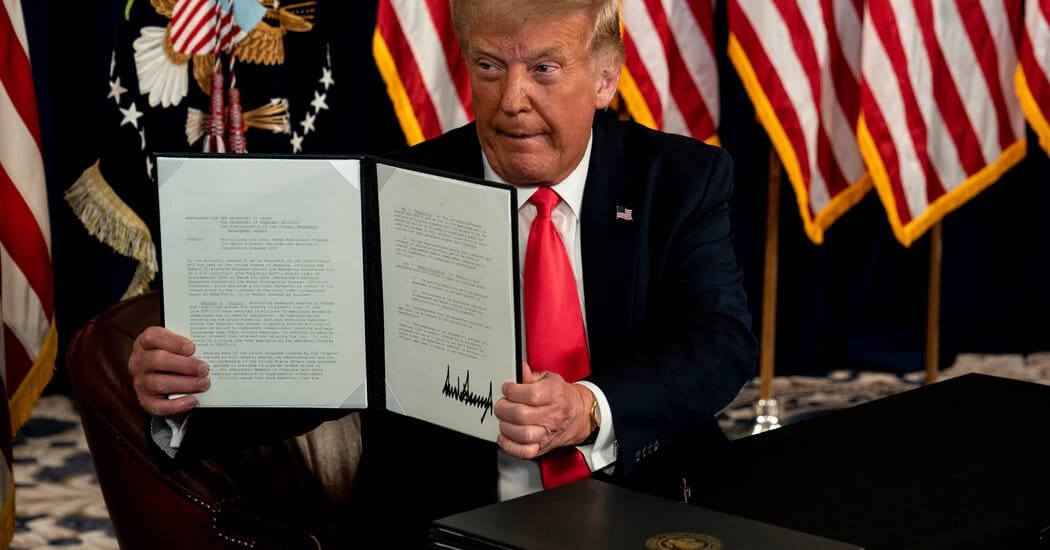
Under the measures that President Trump announced Saturday, those eligible for unemployment aid would receive an extra $400 weekly, with the federal government covering only $300 of that amount and states making up the difference. Above, Mr. Trump with his executive orders.
A number of governors expressed alarm about having to make up the $100 difference, as many states have seen tax revenue plummet during the pandemic. And because Congress controls the federal budget, the president’s directives will almost certainly be challenged in court.
It was unclear when negotiations would resume over how to close the gap between a $3.4 trillion measure the House approved in May and a roughly $1 trillion package that Republicans unveiled last month. Lawmakers have largely left the capital to return to their home districts.
Federal agencies have been asked to submit feedback to the White House by Tuesday, though it was unclear when President Trump might approve or announce the rule. Above, the border between Mexicali, Mexico, and Calexico, Calif.
A draft memo, parts of which were obtained by The Times, said the prohibition would apply “only in the rarest of circumstances,” but if Mr. Trump approved the change, it would be an escalation of his government’s longstanding attempts to seal the border against what he considers to be threats.
3. The Clintons and the Obamas will be among the speakers at the mostly virtual Democratic National Convention next week.
Senator Bernie Sanders of Vermont and former Gov. John Kasich of Ohio, a Republican who is a harsh critic of President Trump, will deliver addresses Monday night. Hillary Clinton, above, will deliver a prime-time speech next Wednesday, as will Senator Elizabeth Warren of Massachusetts if she is not selected as Joe Biden’s running mate, officials said.
Mr. Biden, the former vice president and presumptive presidential nominee, will speak from Delaware on Thursday, the final night of the convention. Former President Barack Obama’s time slot has not been announced, and neither has Michelle Obama’s.
Mr. Biden is expected to announce his running mate this week. His advisers say he has spoken in recent days with several of the leading candidates, as well as Gov. Gretchen Whitmer of Michigan.
And President Trump tweeted that he may make his acceptance speech for the Republican nomination in Gettysburg, Pa., or at the White House.
4. McDonald’s sued its former C.E.O., claiming that he lied about sexual relationships with three employees in the year before his ouster.
Steve Easterbrook, above, was fired and replaced eight months ago for sexting with a subordinate. For the most part, corporate executives under a similar cloud have departed quietly, and companies haven’t aired the ugly details.
But a new allegation from an anonymous tip about Mr. Easterbrook has ignited a public war, with McDonald’s seeking to recoup stock options and other compensation that it allowed Mr. Easterbrook to keep — a package worth more than $40 million, by one estimate.
Mr. Easterbrook’s lawyer didn’t immediately respond to requests for comment.
5. Lebanon’s prime minister and cabinet resigned.
In a televised address, Prime Minister Hassan Diab said he was acting after widespread anger over last week’s explosion, which killed more than 150 people, wounded 6,000 and left hundreds of thousands homeless.
The blast added to existing frustration with the country’s political elite for what many in Lebanon consider decades of corruption and mismanagement. Above, protesters near the Parliament today.
Mr. Diab, in office since January, said his government had sought to put in place changes called for by the Lebanese people but was blocked by political foes he declined to name. It is unclear who will now take charge of the recovery from the blast.
The campaign against the pro-democracy movement has drawn a global outcry. On Friday, the Trump administration placed sanctions on Carrie Lam, Hong Kong’s chief executive, and 10 other officials over their roles in suppressing dissent. China retaliated by sanctioning 11 American nonprofit leaders and lawmakers, including Senators Marco Rubio and Ted Cruz.
7. Chicago police officers arrested more than 100 people on charges of looting, battery against the police and disorderly conduct. A curfew was imposed on downtown starting tonight.
Think about a bar. Alcohol is flowing. It can be loud, but it’s definitely intimate, and you often need to lean in close to hear your friend. And strangers have way, way fewer reservations about coming up to people in a bar. That’s sort of the point of a bar. Feeling good and close to strangers. It’s no surprise, then, that bars have been linked to outbreaks in several states. Louisiana health officials have tied at least 100 coronavirus cases to bars in the Tigerland nightlife district in Baton Rouge. Minnesota has traced 328 recent cases to bars across the state. In Idaho, health officials shut down bars in Ada County after reporting clusters of infections among young adults who had visited several bars in downtown Boise. Governors in California, Texas and Arizona, where coronavirus cases are soaring, have ordered hundreds of newly reopened bars to shut down. Less than two weeks after Colorado’s bars reopened at limited capacity, Gov. Jared Polis ordered them to close.
I have antibodies. Am I now immune?
As of right now, that seems likely, for at least several months. There have been frightening accounts of people suffering what seems to be a second bout of Covid-19. But experts say these patients may have a drawn-out course of infection, with the virus taking a slow toll weeks to months after initial exposure. People infected with the coronavirus typically produce immune molecules called antibodies, which are protective proteins made in response to an infection. These antibodies may last in the body only two to three months, which may seem worrisome, but that’s perfectly normal after an acute infection subsides, said Dr. Michael Mina, an immunologist at Harvard University. It may be possible to get the coronavirus again, but it’s highly unlikely that it would be possible in a short window of time from initial infection or make people sicker the second time.
I’m a small-business owner. Can I get relief?
The stimulus bills enacted in March offer help for the millions of American small businesses. Those eligible for aid are businesses and nonprofit organizations with fewer than 500 workers, including sole proprietorships, independent contractors and freelancers. Some larger companies in some industries are also eligible. The help being offered, which is being managed by the Small Business Administration, includes the Paycheck Protection Program and the Economic Injury Disaster Loan program. But lots of folks have not yet seen payouts. Even those who have received help are confused: The rules are draconian, and some are stuck sitting on money they don’t know how to use. Many small-business owners are getting less than they expected or not hearing anything at all.
What are my rights if I am worried about going back to work?
What is school going to look like in September?
It is unlikely that many schools will return to a normal schedule this fall, requiring the grind of online learning, makeshift child care and stunted workdays to continue. California’s two largest public school districts — Los Angeles and San Diego — said on July 13, that instruction will be remote-only in the fall, citing concerns that surging coronavirus infections in their areas pose too dire a risk for students and teachers. Together, the two districts enroll some 825,000 students. They are the largest in the country so far to abandon plans for even a partial physical return to classrooms when they reopen in August. For other districts, the solution won’t be an all-or-nothing approach. Many systems, including the nation’s largest, New York City, are devising hybrid plans that involve spending some days in classrooms and other days online. There’s no national policy on this yet, so check with your municipal school system regularly to see what is happening in your community.
Hundreds of people converged early Monday on the city’s upscale shopping district, breaking windows and ransacking stores. The chaotic scene prompted officials to briefly raise bridges downtown and halt nearby public transit. Thirteen police officers, a civilian and a security guard were injured. Above, Yogi Dalal with his daughters Jigisha, right, and Kajal at the family food and liquor store after it was vandalized.
The police said the looting had apparently grown out of a shooting between the police and a man with a gun that took place on the South Side. Like many other cities across the country, Chicago has seen a spike in gun crimes this summer.
“What occurred downtown and in surrounding communities was abject criminal behavior, pure and simple,” Mayor Lori Lightfoot said this morning.
8. This could be the largest public gathering in the U.S. since the first coronavirus cases emerged here in the spring.
Officials expected about 250,000 motorcycle enthusiasts, about half the attendance of last year, in Sturgis, S.D., for the town’s annual biker rally.
We spoke with a few of those attending about why they came. Many said they were not concerned about the virus, as they walked around without masks, took helicopter rides and attended outdoor concerts and motorcycle shows.
9. Amazon has plans to launch 3,236 satellites. SpaceX’s goal is 12,000. And OneWeb has already put hundreds into orbit.
They all aim to extend high-speed internet service around the world, including to remote or underserved communities. But astronomers are worried.
With only about 2,600 satellites aloft right now, skywatchers are increasingly alarmed because of the orbs’ propensity to photobomb astronomical images with bright streaks. Above, a long-exposure image of a satellite’s track in the sky near Salgotarjan, Hungary.
Scientists are also worried about the lack of regulation as more entrants join the action. “It feels like putting a bunch of planes up and then not having air traffic control,” a planetary astronomer in New Zealand said.
10. And finally, if you drink Fresca or Squirt, you’re now also swallowing the latest mosquito repellent.
Nootkatone, an oil found in cedar trees and grapefruits, won approval today from the Environmental Protection Agency as an insect repellent. It is so safe that it is used as a flavor and fragrance by the food and perfume industries.
The chemical is not oily, lasts for hours and has a grapefruit-like scent. And it repels mosquitoes, ticks (like the one above), bedbugs and fleas, according to the Centers for Disease Control and Prevention. Bonus: It may also be effective against lice, sandflies, midges and other pests.
Have an all-natural evening. And don’t let the bedbugs bite.
Your Evening Briefing is posted at 6 p.m. Eastern.
Image caption
TSB customers complained they were unable to access their accounts online
Some TSB customers couldn’t access online banking services on Monday.
Users on both the app and the website received error messages when trying to access their accounts.
There are dozens of comments on social media saying affected customers were unable to get past the security questions, some for several hours.
The bank said it was working to fix the issue as quickly as possible, and that only a “very small number” of people were affected.
A number of users reported their accounts had been blocked while trying to log in with the correct details.
Image copyright @AshdonHusky
Others complained that they could not access support for this issue over the phone or via Twitter.
Image copyright @elbagallery
It was also suggested that the difficulties had started over the weekend.
A TSB spokesperson told the Moneysaving Expert website:
“We’re aware a very small number of customers have been experiencing issues accessing their internet banking today.
“We’re working to fix this for them as quickly as possible and apologise for any inconvenience caused. Our mobile banking app remains fully functioning.”
And last year, a “processing error” meant wages and other payments were not paid into some TSB customers’ accounts.
In April 2018, a similar IT failure left up to 1.9 million TSB customers unable to bank online for several weeks.
Customers were moved on to a new system, but an investigation found it had not been tested properly before going live. It cost TSB a total of £330m for customer compensation, fraud losses and other expenses.
Pac 12 Players Say Commissioner Was Dismissive of Their Virus Concerns
Knowing that some schools might balk at the cost of such regular testing, the players urged the conference to ask Stanford, whose medical school recently received federal approval for pooled testing, which greatly increases testing capacity and efficiency, to make it available to the conference’s other schools at wholesale cost.
“This virus doesn’t look at if you’re a professional or amateur; it has the potential to harm,” Daltoso said in explaining why the players want the same protections the N.F.L. is providing when teams begin blocking and tackling and cannot social distance. “We play a full contact sport; I think guys made it very clear that working out is not the issue. We’re 10 days away from practice — we don’t need guidelines, we need mandates, rules that schools all across the conference need to follow.”
The players said Scott told them the conference could not impose testing standards on its universities, and referenced a 17-page pamphlet the conference produced laying out recommendations. If schools do not follow the recommendations, the players said Scott told them: “We hope to discuss that.”
“That’s not enough,” Daltoso said. “We’re asking for the schools to follow concrete mandates.”
The need for such mandates was underscored, the players said, by recent cases in which players have had lengthy and arduous recoveries from the virus — including the case of Brady Feeney, a freshman lineman at Indiana whose mother posted on Facebook that he was facing possible heart issues and his blood work had troubled doctors.
The players said Scott several times urged the players to opt out if they were uncomfortable playing, but that, they said, brought its own concerns. Two players at Washington State, receiver Kassidy Woods and defensive lineman Dallas Hobbs, said that after they aligned themselves with the #WeAreUnited group, Coach Nick Rolovich told them they would be treated differently, and they could not see doctors or trainers or use the dining hall and had been removed from a team messaging app. (Hobbs participated in Thursday’s call.)
On the call, Harlan, the Utah athletic director, told the group that Utah players who opt out would be allowed the same access to mental health, food and health services that the rest of the team had, but that using team facilities to stay in shape could be problematic.
But Nick Ford, a senior offensive lineman at Utah, said that when he sought clarification about whether the policy that Harlan laid out applied more broadly, Scott told him that players who opted out were “not allowed to cherry-pick from services.” Ford added that Scott criticized him directly, saying Ford was “talking out both sides of my mouth.”
Former Angels Employee Charged in Pitchers Overdose Death
A former employee of the Los Angeles Angels was charged with conspiracy to distribute fentanyl in connection with the fatal overdose of Tyler Skaggs, a pitcher for the team, federal prosecutors announced on Friday.
The former employee, Eric Prescott Kay, who worked as the team’s communications director, surrendered himself in Fort Worth and appeared before a judge Friday morning, according to court records. Mr. Kay, 45, was released on bond.
“No one is immune from the deadly addictive nature of these drugs,” Erin Nealy Cox, the U.S. attorney for the Northern District of Texas, said at a news conference Friday morning.
“Suppressing the spread of fentanyl — and preventing tragedies like Tyler Skaggs’s and the thousands of other Americans who die every year from fentanyl overdoses — is a priority of the Department of Justice,” she added.
In July 2019, Mr. Skaggs, 27, was found dead in a hotel room at the Hilton Dallas Southlake Town Square Hotel just before his team was scheduled to play the Texas Rangers. An autopsy report released a month later revealed that Mr. Skaggs had fentanyl and oxycodone in his system at the time of his death.
The Tarrant County Medical Examiner’s Office later determined that Mr. Skaggs would not have died had he not consumed fentanyl, prosecutors said in a statement on Friday.
“The family is deeply heartbroken to learn that Tyler would be alive today were it not for a pill containing fentanyl that was provided by the director of communications of the Angels,” Rusty Hardin, a lawyer for Mr. Skaggs’s family, said in a statement on Friday.
Michael Molfetta and Reagan Wynn, lawyers for Mr. Kay, said in a statement on Friday that what happened to Mr. Skaggs was a tragedy, and that “addiction is a debilitating and destructive disease.”
“Today, our client, Eric Kay, willingly traveled to Texas from California to surrender himself,” they wrote. “Now he will patiently wait for his opportunity to make his story known.”
Fentanyl is a synthetic opioid that is 50 to 100 times more potent than morphine, Ms. Nealy Cox said. While a smaller portion is used for medical settings, the vast majority of fentanyl is illegally produced.
Many who overdose on fentanyl do not even know they took it, because dealers will often produce counterfeit drugs using fentanyl and then stamp on the manufacturer’s markings to make it look like they are pharmaceuticals, like oxycodone, a prescription pain killer, Ms. Nealy Cox said.
A criminal complaint filed on July 30 but unsealed on Friday reveals that investigators found several pills and white residue in Mr. Skaggs’s hotel room. An analysis later found that both a single blue pill that closely resembled a 30-milligram oxycodone tablet and the white residue contained fentanyl.
Five pink pills also found were determined to be legitimately manufactured five-milligram oxycodone pills that did not contain fentanyl. Several white pills were later found to be anti-inflammatories, according to the complaint.
In an initial interview with law enforcement, Mr. Kay said the last time he had seen Mr. Skaggs was when they checked into the hotel on June 30, 2019. He is also said to have denied knowing whether Mr. Skaggs used drugs.
Mr. Skaggs asked Mr. Kay to stop by his room and possibly discussed bringing pills later that evening, a search of Mr. Skaggs’s phone revealed, the complaint said.
Mr. Kay had also allegedly told someone that he had visited Mr. Skaggs’s room on the night he died, contrary to what Mr. Kay initially told law enforcement, the complaint said.
The Drug Enforcement Administration found that Mr. Kay had allegedly dealt the blue pills — variously called “blues” or “blue boys” — to Mr. Skaggs several times and to others. Several people who knew Mr. Kay and Mr. Skaggs allege that Mr. Kay provided 30-milligram oxycodone pills to Mr. Skaggs and others, the complaint said.
A former federal prosecutor conducted an independent investigation for the Angels, the team announced on Friday.
“We learned that there was unacceptable behavior inconsistent with our code of conduct, and we took steps to address it,” the Angels said in a statement. “Our investigation also confirmed that no one in management was aware, or informed, of any employee providing opioids to any player, nor that Tyler was using opioids.”
Mr. Skaggs’s family urged the Angels to make public the report from their investigation, according to Mr. Hardin’s statement.
“We are relieved that no one else who was supplied drugs by this Angels executive met the same fate as Tyler,” the family’s lawyer said. “While nothing will replace the loss of Tyler, we are very grateful to federal prosecutors for their diligent and ongoing work.”
The New York Times surprisingly demolished the mainstream media’s previous narrative that Seattle’s police-free “Autonomous Zone” was a peaceful area with a block party atmosphere by speaking with local business owners who are now suing the city over the damage caused.
Liberal news outlets largely downplayed the six-block downtown area, first dubbed the “Capitol Hill Autonomous Zone” (CHAZ) and later Capitol Hill Organized Protest (CHOP), because of its location in the city’s Capitol Hill neighborhood. CNN largely dismissed the chaos, while The New York Times itself celebrated the area as “a homeland for racial justice.”
NEW YORK TIMES CELEBRATES SEATTLE PROTESTERS’ ‘AUTONOMOUS ZONE’: ‘A HOMELAND FOR RACIAL JUSTICE’
Townhall senior reporter Julio Rosas, who was on the ground in Seattle at the height of the chaos, told Fox News that the media was downplaying the story.
“I think the biggest misperception in the media is that only good things are happening in and around the autonomous zone,” Rosas said in June.
Two months later, New York Times reporter Nellie Bowles hit Seattle to decide for herself. The result was a report headlined, “Abolish the Police? Those Who Survived the Chaos in Seattle Aren’t So Sure,” in which business owners described the “harrowing experience of calling for help and being left all alone” that contradicts the media’s previous narrative.
The Times spoke with a local business owner who had heard the area had a “block party atmosphere,” which Seattle Mayor Jenny Durkan famously said on CNN.
“But that was not what he saw through the windows of his Seattle coffee shop. He saw encampments overtaking the sidewalks. He saw roving bands of masked protesters smashing windows and looting,” the Times reported, noting the man saw “young white men wielding guns.”
The area was celebrated by liberal lawmakers and pundits until it turned deadly, even though President Trump and pundits on the right had declared the area unsafe from the beginning. The protest coincided with nationwide calls to “defund the police,” but local business owners don’t seem to think that’s a good idea any longer.
HANNITY BLASTS WASHINGTON GOV. SEATTLE MAYOR AMID CHAZ CHAOS: ‘DOING NOTHING TO PROTECT THEIR PEOPLE’
“Business crashed as the Seattle police refused to respond to calls to the area. Officers did not retake the region until July 1, after four shootings, including two fatal ones,” the Times reported, noting that local businesses owners are now suing the city.
“The lawsuit claims that ‘Seattle’s unprecedented decision to abandon and close off an entire city neighborhood, leaving it unchecked by the police, unserved by fire and emergency health services, and inaccessible to the public’ resulted in enormous property damage and lost revenue,” the Times reported.
MAINSTREAM MEDIA DOWNPLAYS ‘INSANITY IN SEATTLE’ AS CRITICS POINT OUT BIAS, HYPOCRISY
The impact of the occupation on Cafe Argento, whose owner is a part of the lawsuit, has been “devastating,” according to the Times.
“Very few people braved the barricades set up by the armed occupiers to come in for his coffee and breakfast sandwiches. Cars coming to pick up food orders would turn around. At two points, he and his workers felt scared and called 911,” the Times reported.
“It was lawless,” the business owner told the Times.
CLICK HERE FOR THE FOX NEWS APP
The Times report now paints the area as a graffiti-filled mess filled with shattered glass, broken street lights and gun-toting private security guards. A Black Lives Matter community guard told the Times he “was appalled by the violent tactics and rhetoric he witnessed during the occupation.”
The Times went a different route in June, embracing the area with a glowing feature, “Free Food, Free Speech and Free of Police: Inside Seattle’s ‘Autonomous Zone.’”
Image caption
The penguins are symbols of Tencent’s iconic messaging platform QQ, which launched five years before Facebook, in 1999
Based in Shenzhen and founded in 1998, the Chinese company Tencent enjoys huge popularity – and profits – in China.
Its cute penguin symbol is as familiar to Chinese children as the McDonalds “golden arches” logo is to children in the West, says the BBC’s China media analyst Kerry Allen.
“Tencent is thought of as so much more than just a Chinese company in China – it has gained a reputation as a family-friendly organisation that connects families, friends and work colleagues in a digital age,” she said.
“It has a business model that other Chinese companies can only envy – it can reach an audience of, basically, everyone.”
But many people in the West have never heard of it.
That doesn’t mean it isn’t present in our everyday lives, though – Tencent also owns chunks of some of Western culture’s most popular games, music and movies.
Like Google’s parent company, Alphabet, Tencent has a broad portfolio of interests, although arguably it remains best known for its messaging services.
US president Donald Trump singled out the app WeChat in his most recent executive order, which demands US firms stop doing business with it.
WeChat has over a billion users, both inside China and around the world – the Chinese version is called Weixin.
It is often compared to WhatsApp – and certainly it is widely used for messaging – several US messaging apps and social media sites are banned by the Chinese state so you can’t (officially) Facebook message a friend in Beijing, for example.
But there’s a lot more to WeChat than messaging.
Image copyright Getty Images
Image caption
WeChat has over one billion monthly users
It’s more akin to a separate operating system: just like you might use Google’s Android or Apple’s iOS for a variety of tasks, it is used to read news, pay bills, order transport or food, and run small businesses.
The firm has not revealed just how profitable WeChat is on its own, but it is clear that Tencent – as a whole – is thriving.
Image copyright Getty Images
Image caption
Tencent’s headquarters are in Shenzhen
Earning results for the first quarter of 2020 showed a total revenue of 108 billion Chinese yuan ($15.2 billion) – an increase of 26% year-on-year, despite the coronavirus pandemic. Alphabet’s revenue for the same period was $41.2 bn.
Crunchbase’s Tencent entry lists 479 investments, with a fund totalling $6.6bn. It would be tedious to go through them all, but let’s take a quick look at some of them.
Gaming
It is clear that Tencent makes a lot of money via gaming.
Tencent is the largest video games publisher in the world. It has a stake in the two most popular Battle Royale-style games: Fortnite and PlayerUnknown’s Battlegrounds (PubG).
Image copyright Fortnite
It owns a 40% stake in Fortnite studio, Epic games, and has the license to PlayerUnknown’s Battlegrounds (PubG) – although it failed in its own battle to get the game approved for distribution in China.
It also owns the entire League of Legends studio, Riot Games.
In October 2019, PC Gamer published a list of 16 games firms outside of China that Tencent had publicly invested in, including Ubisoft and Discord.
Music and movies
It also invests in Western music and films.
Tencent has recently completed a deal giving it a 10% stake in Universal Music. The record label includes major artists such as Lady Gaga, Taylor Swift, Drake and Kendrick Lamar on its books.
In addition, Tencent already has its own music division – Tencent Music Entertainment (TME).
And a share-swap in 2017 saw it take a 7.5% stake in streaming giant Spotify (Spotify got 9.5% of TME in return, reported Tech Crunch at the time).
Tencent Pictures, its film and production arm, has been involved in a large number of Hollywood movies, including Terminator: Dark Fate (2019), Wonder Woman (2017) and the upcoming Top Gun sequel, Top Gun: Maverick – scheduled for release in 2021.
Oh – and there’s also the small matter of the Chinese giant owning 5% of the US electric car firm Tesla.
What is the US concerned about?
President Donald Trump says that the spread in the US of mobile apps developed and owned by Chinese firms “threaten the national security, foreign policy, and economy of the United States”.
The US government says both Bytedance’s TikTok and Tencent’s WeChat “capture vast swaths of information from its users”.
“This data collection threatens to allow the Chinese Communist Party access to Americans’ personal and proprietary information,” it claims.
Tencent’s chief executive and co-founder Ma Huateng, known as Pony Ma, is widely assumed to support the Communist Party. He is a member of the National People’s Congress (NPC), China’s national parliament.
Trump’s executive order also claims both WeChat and TikTok gather data on Chinese nationals visiting the US, allowing Beijing “to keep tabs” on them.
Prof Alan Woodward, a cyber security expert from Surrey University, points out that for international users, WeChat data sits on servers outside of China – meaning in theory that it is more protected from state scrutiny.
However, he added that WeChat’s privacy policy openly states that it will “comply with any legal requests from state agencies to hand over data they have in their servers”.
“Just as with TikTok, the concern is that the parent company is Chinese and thus it may be argued that they are indeed subject to the Chinese Intelligence Act,” he said.
Tencent has so far issued the briefest of responses to the news from the US: “We are reviewing the executive order to get a full understanding,” it said.