Sunday, February 8, 2026
-10.1 C
Washington D.C.
Home Blog Page 102

Twitter beefs up security for US election candidates

0

[ad_1]

Joe Biden looks down at his smartphone while standing against a giant stage drop background in bright red

image copyrightGetty Images

image captionDemocratic presidential candidate Joe Biden’s account was compromised in June

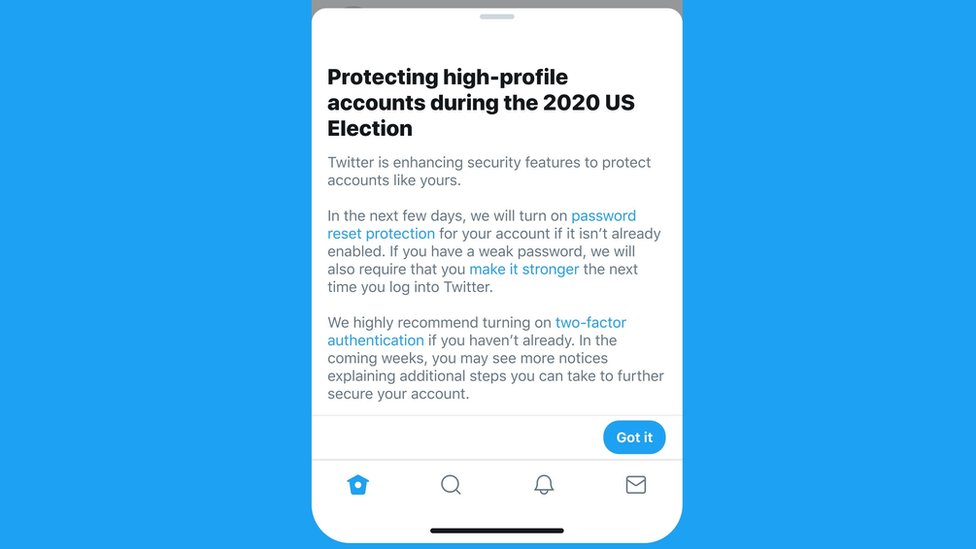
Twitter has automatically activated extra account protection for politicians and key figures in the forthcoming US election.

A select group of election-related accounts will have to make immediate changes to improve their security.

Twitter was the victim of one of the most significant hacks of a social network in history, in June.

It said it had learned “from the experience of past security incidents” and was focused on election security.

Twitter said that in the coming weeks, it would be adding “proactive internal security safeguards” for a much wider range of high-profile election-related accounts.

  • The Executive Branch (including the president and vice-president)
  • Congress (The House of Representatives and the Senate)
  • US governors and secretaries of state
  • Presidential campaigns, political parties and candidates
  • Significant news outlets and political journalists

Starting this week, those accounts will start receiving in-app notifications of immediate changes on the user’s side.

Under the new rules, they will need to use a strong password – those that do not meet Twitter’s standards will be required to change it the next time they log in.

All the accounts have had password reset protection enabled by default – a safety measure that requires the account holder to confirm the email address and password on file if they want to reset their password.

And they will also be encouraged – but not required – to enable two-factor authentication.

Hack history

The June hack saw some of the world’s most notable celebrities – such as Bill Gates, Joe Biden and Kanye West – have their accounts seized by the attacker to tweet an apparently simple Bitcoin scam.

But one of Twitter’s most-followed accounts – US President Donald Trump – was unaffected. It later emerged that this was because the president’s account had extra security protections in place internally.

image copyrightTwitter

The change comes at a time when Twitter is locked in a battle against electoral misinformation on the platform – one that has put it at odds with President Trump.

It had previously tagged some of the tweets for breaching policies on glorifying violence and abusive behaviour.

But the wider concern about the role of the social media companies in the election stems from the 2016 presidential campaign, which saw President Trump win his first term in office.

In the wake of the election, the US Senate and others said that Russian operatives had tried to leverage all major social media outlets to influence the outcome.

Related Topics

  • Twitter

  • Cyber-security
  • United States


[ad_2]

Source link

Louisville Metro Council passes vote of no confidence against mayor over handling of Breonna Taylor case

0
The resolution, which passed 22 to 4, also outlines a detailed list of actions the mayor needs to take in order to “restore trust between the residents of Louisville Metro and its government and to ensure the safety and equality of all its residents.”

Some of the actions include advancing policies for social and racial equity, committing to total transparency of government actions and a full review of the Louisville Metro Police Department by the end of this year.

The resolution states there will be further steps by the council if the mayor fails to advance these actions. Many council members expressed irritation during the two-hour debate over the resolution, saying it lacked accountability and that the metro council was the only mechanism for holding the mayor to the demands.

In a video statement after the vote, Fischer said this is an opportunity for the council, his office and the community as a whole to work together for the city’s transformation.

“We have enormous challenges ahead and to move forward, we need to pull together. And we must work together in both good times and tough times like these. Several of the policy ideas discussed by council are under way and together we have already made changes in LMPD policies and procedures,” he said.

The original resolution, which was authored by a group of Republican council members, sharply criticizes Fischer’s actions and explicitly asked for his resignation. The resolution that passed does not include that language and was amended by Democrat Markus Winkler. It focuses on the council and mayor working together to move the list of desired actions forward.

The resolution only serves as a recommendation from the council. If called for, the council does not have the sole power to remove Fischer from office.

“I would just say that I hope we take this as an opportunity to find a path forward,” Winkler said during the meeting. “I hope the administration sees it as an opportunity to work together to improve the lives for all of the residents of Louisville Metro, and I appreciate President James’s work and everyone else’s work on this.”

Louisville Metro Police officers fatally shot Taylor after they broke down the door to her apartment while executing a late-night, “no-knock” warrant in a narcotics investigation on March 13.
Police believed Taylor was home alone when she was in fact accompanied by her boyfriend, who was legally armed, according to a CNN review of the shooting. That miscalculation, along with the decision to press forward with a high-risk, forced-entry raid under questionable circumstances, contributed to the deadly outcome.
None of the three officers involved in the flawed raid has been charged with a crime.

The city of Louisville has agreed to pay $12 million to Taylor’s family and institute sweeping police reforms in a historic settlement of the wrongful death lawsuit.

Source link

Tesla driver charged over ‘napping while speeding’

0

[ad_1]

Image supplied by Alberta police of the detained Tesla carImage copyright
Alberta RCMP

Image caption

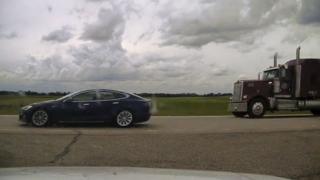
The car had been driving along a highway near Ponoka in Alberta

A Canadian man has been charged with dangerous driving for allegedly taking a nap while his self-driving Tesla car clocked up more than 90mph (150km/h).

Police said both front seats were fully reclined, and the driver and passenger were apparently asleep when they were alerted to the incident in Alberta.

When police turned on emergency lights and other vehicles moved out of the way, the Tesla Model S sped up.

The 20-year-old driver from British Columbia is due in court in December.

He had initially been charged with speeding and handed a 24-hour licence suspension for fatigue, but was subsequently charged with dangerous driving.

The incident happened near Ponoka, some 100km south of Edmonton, in July.

“Nobody was looking out the windshield to see where the car was going,” Police Sgt Darri Turnbull told CBC News.

He said that when they put on their emergency lights the Tesla accelerated, with vehicles ahead of it moving out of the way.

“Nobody appeared to be in the car, but the vehicle sped up because the line was clear in front.”

He added: “I’ve been in policing for over 23 years, and the majority of that in traffic law enforcement, and I’m speechless. I’ve never, ever seen anything like this before but of course the technology wasn’t there.”

Tesla cars currently operate at a level-two Autopilot, which requires the driver to remain alert and ready to act, with hands on the wheel.

Tesla founder Elon Musk has said he expects his vehicles to be completely autonomous, with little driver input needed, by the end of the year.

However, he added that there were “many small problems” that would need solving through real-world testing.


[ad_2]

Source link

Nintendo 3DS discontinued after almost a decade

0

[ad_1]

A 3DS product shot

image copyrightGetty Images

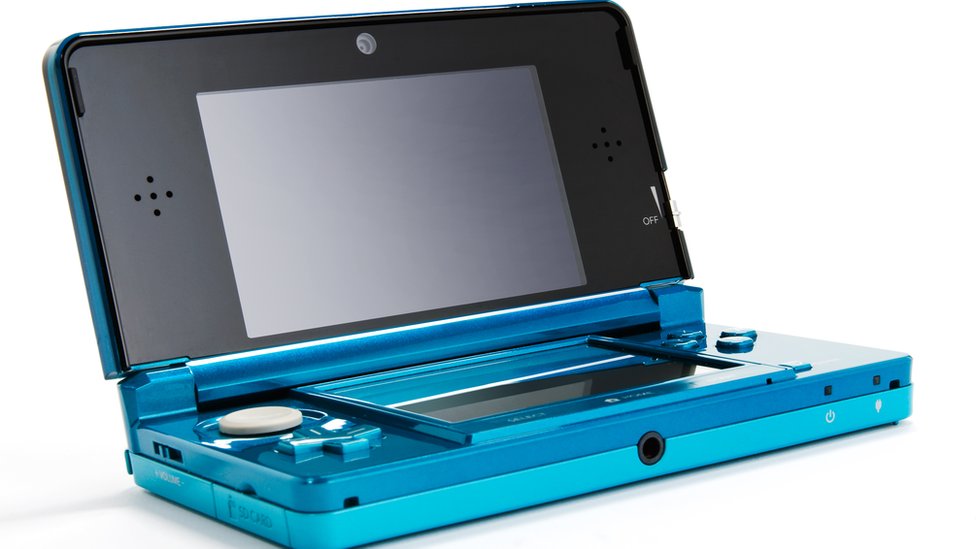
image captionLaunched in early 2011, the 3DS went through several redesigns

Nintendo has discontinued its 3DS handheld after about 76 million sales over a nine-and-a-half year period.

A notice on the Japanese firm’s site says “manufacturing of the Nintendo 3DS family of systems has ended”.

The device had the ability to trick the human eye into seeing 3D images like those in some cinema screenings – but without special glasses.

However, its launch received a lukewarm reception and it only gained popularity later.

The console’s demise has long been expected. Last year, the company said it no longer planned to make any new first-party games for the system.

It means the original Nintendo DS retains the title of being the bestselling mobile console.

And the Nintendo Switch – a hybrid handheld-and-home machine – is the current focus of Nintendo’s efforts.

Glasses-free 3D

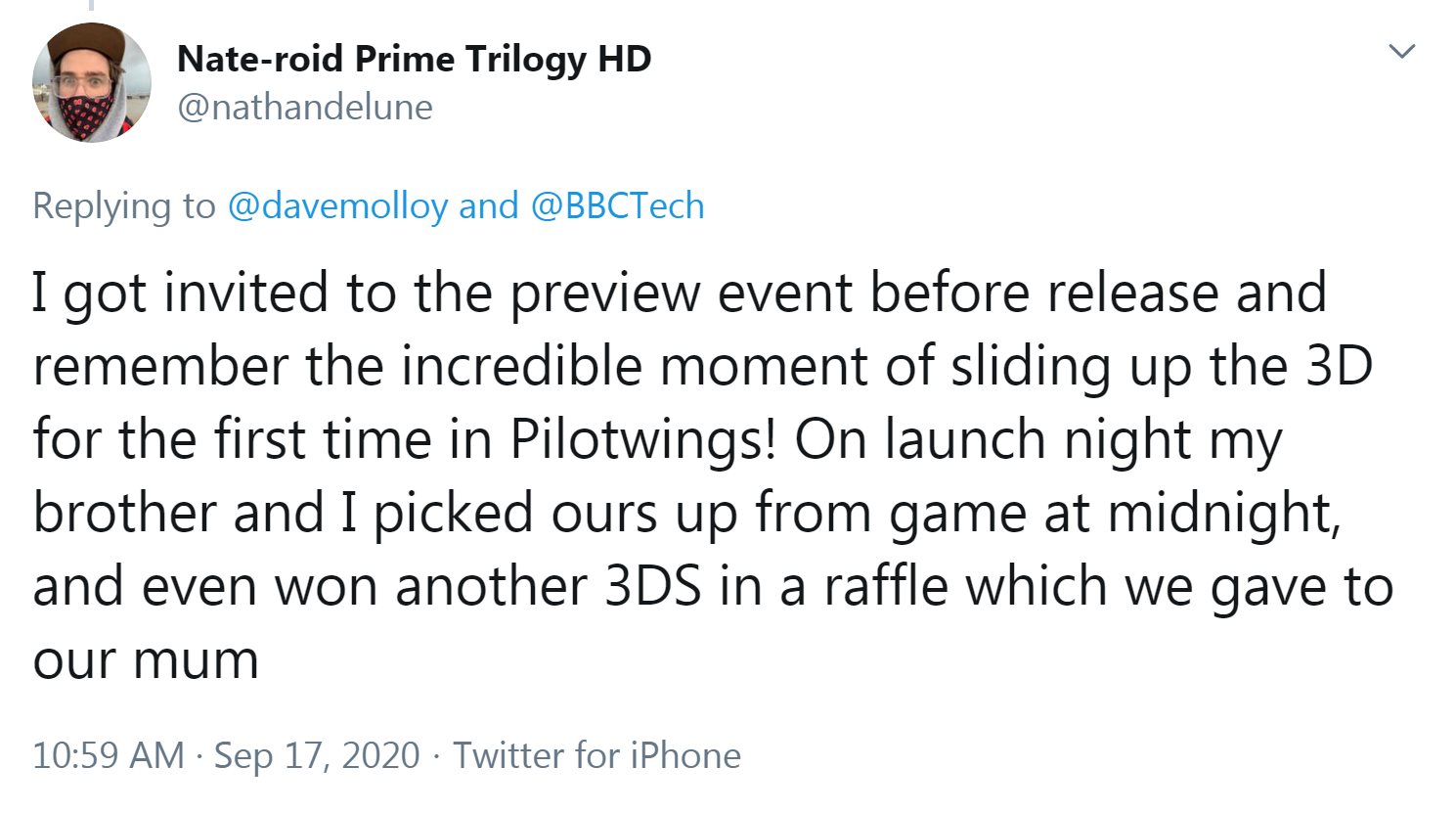
The unique selling point of the 3DS was its stereoscopic 3D effect coming from the screen itself, turned on with a simple slider.

The optical illusion only works when the screen is in a very specific spot in front of the face – but exactly where gamers tend to hold handheld consoles.

It was impossible to showcase on video or photo but impressed many who tried it.

image copyrightTwitter / nathandelune

In its 2011 review, game site IGN wrote: “Once you’re in the 3D sweet spot… the 3DS looks amazing; graphics look clean, characters and objects are sharp, and ghosting effects are limited, creating a rich, immersive gameplay experience unlike anything we’ve seen on a handheld before.”

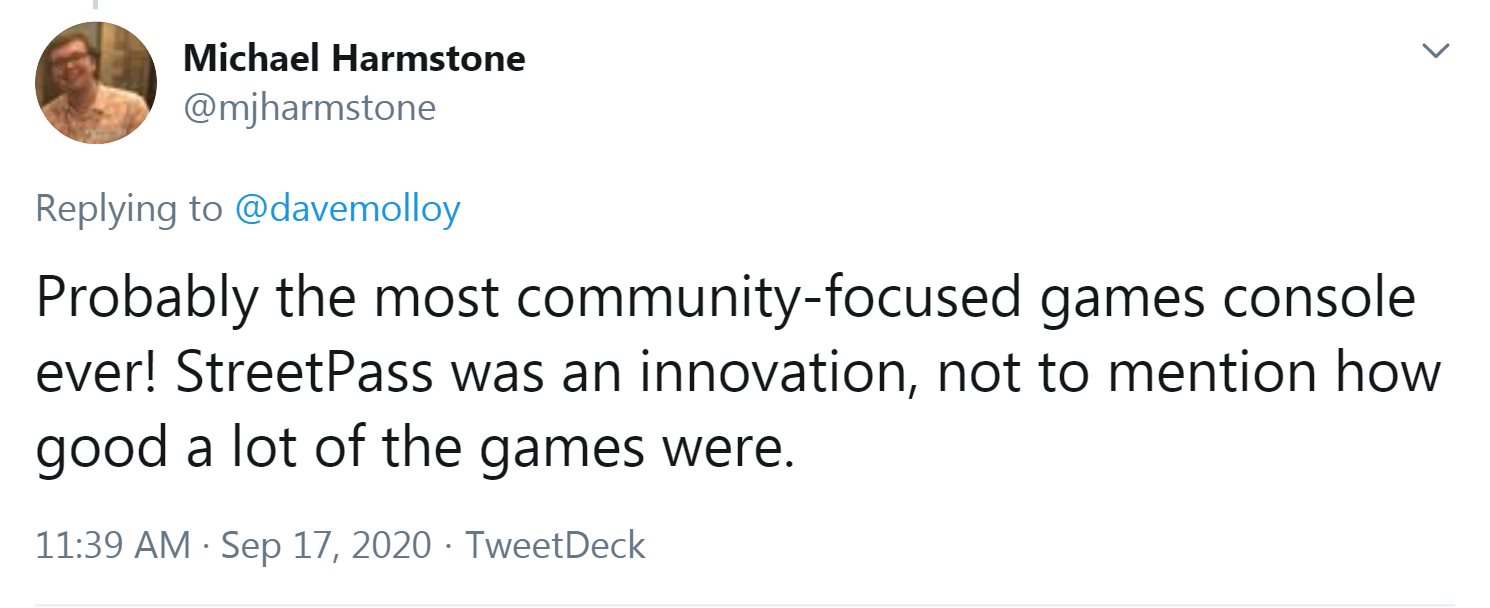
The console was packed with experimental features – augmented reality games, dual 3D cameras, and the the ability to detect nearby consoles while in low-power standby, called “Streetpass” – which allowed players to connect with strangers without exchanging any information.

image copyrightTwitter / mjharmstone

“The 3DS and its StreetPass functionality were driving factors for the founding of many of the groups now found in [Nintendo Players UK],” said player John Edwards. “Without the 3DS I doubt we’d have such a thriving community.”

Slow starter

Despite all the bells and whistles, the 3DS did not start well. A high asking price for the time of over £200, coupled with a lacklustre list of initial games, hurt sales. The fact that the key feature of 3D had to be tried in person was another obstacle.

On top of that, some users reported that the 3D effect made them feel sick. Nintendo even advises to this day that children under six should not use the facility as it could cause vision damage.

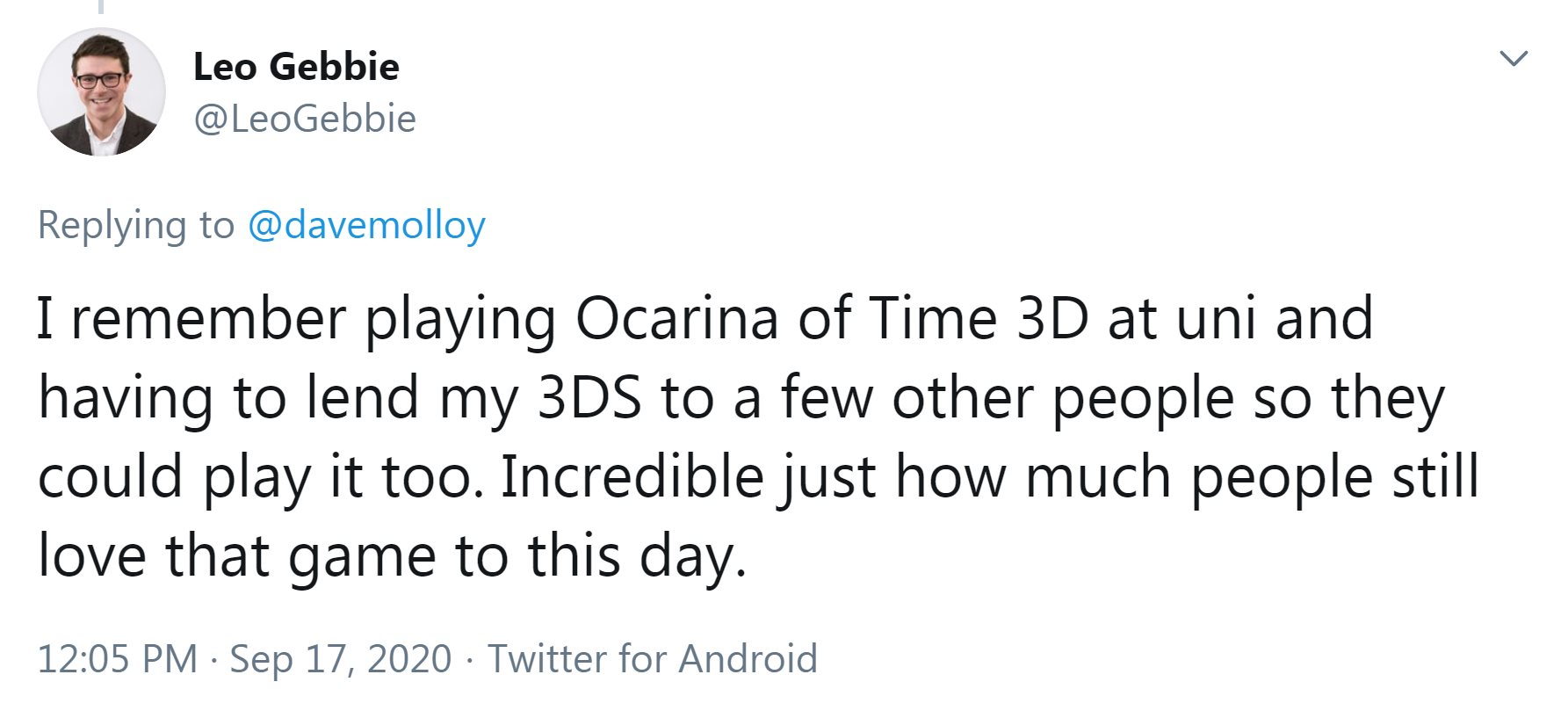
Within six months of the launch, Nintendo announced a major price cut to between £100 and £150. Coupled with more games – including a beloved remake of the classic Ocarina of Time – the fortunes of the handheld started to change.

image copyrightTwitter / LeoGebbie

In 2012, a new version with a larger screen was launched, and Nintendo debuted digital downloads of games for the first time. That online store allowed Nintendo to re-release many of its best-loved classics on the handheld.

“It became a fantastic Nintendo machine for legacy content,” recalls games writer Nathan Ellingsworth.

“It was how I experienced Majora’s Mask, Earthbound, Minish Cap and many more for the first time and it had its own steady stream of incredible titles.”

Making the switch

The 3DS quickly came into its own, with dedicated Mario titles and new Pokemon games in addition to its growing back catalogue.

It was revamped and relaunched several times – on top of the “XL” models, the “New 3DS” had increased horsepower, while the 2DS dropped the standout 3D feature entirely for those who saw it as a gimmick.

By June 2020, the entire system family had sold nearly 76 million units, Nintendo says – far outclassing its home console of the same era, the WiiU, which sold less than 14 million.

image copyrightGetty Images
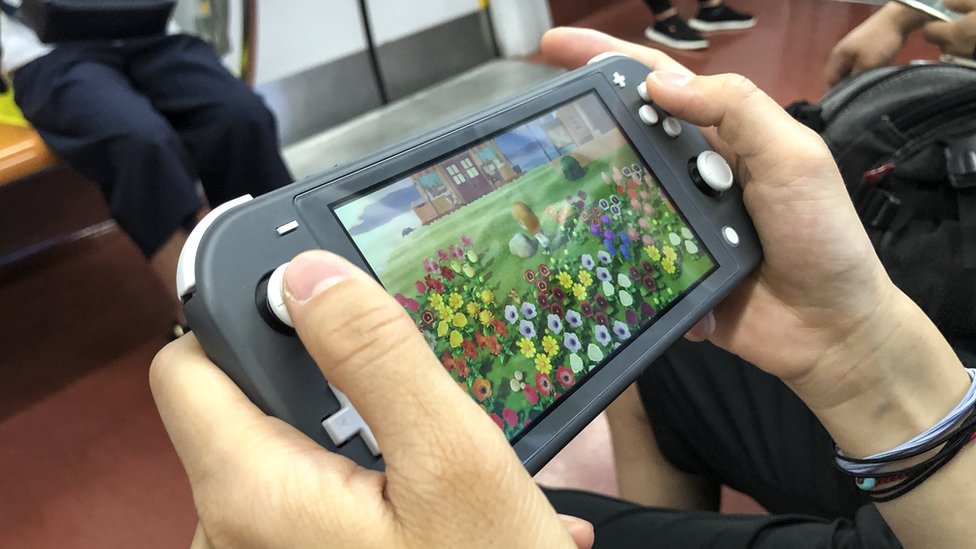
image captionThe higher-resolution, more powerful Switch has largely taken the place of the 3DS

But the modern Nintendo Switch, released in 2017, has already sold more than 60 million units, and can be played as a handheld.

While Nintendo initially insisted it was not a “replacement” for the 3DS, declining support and sales meant the venerable handheld’s time was limited. In the year to March 2020, only 69,000 3DS consoles were sold.

Related Topics

  • Nintendo

  • Gaming

[ad_2]

Source link

Phil Mickelson returns to scene of his most crushing defeat aiming for career grand slam at U.S. Open

0

The course was the site of his most excruciating defeat when in 2006, needing just a par on the final hole — or a bogey to take it to a playoff — to claim his first U.S. Open title, the American hit the ball off a hospitality tent and made a double-bogey, handing the title to Geoff Ogilvy.

And while the crushing nature of that defeat didn’t hold Mickelson back — he went on to win two more majors — the memories from Winged Foot will no doubt forever stick with him.

While the career grand slam still remains elusive to Mickelson as he returns to Winged Foot for the 120th U.S. Open Championship, which begins on Thursday, one thing that has changed is his body. He took to Twitter to show his transformation since 2006, admitting he looks a little “different” now.

“Last time I was at Winged Foot, I was 36 years old with no accountability for my health … After becoming accountable for my own health, today I return to Winged Foot and let’s just say I look a little ‘different.'”

Mickelson waits to hit from the rough during the final round of the 2006 U.S. Open Championship.

A tough test

When Mickelson lost that heartbreaker at Winged Foot 14 years ago, the winning score was five over par. The score to make the cut that year was 13 over.

In contrast to the 13 under Gary Woodland shot in June last year to win the U.S. Open at Pebble Beach, many are expecting another over-par score to win the championship in 2020.

The winning score has been over par in all but one U.S. Open at Winged Foot; Jack Nicklaus once described the course as getting “tough on the first tee and never getting any easier.”
And after playing the course before the Tour Championship last week, Jon Rahm — the world No.2 — believes players will once again struggle to make birdies.
“It’s just a difficult course. It’s long. It’s narrow. It’s undulated,” the Spaniard said. “You just need to play really good golf.

“If it gets firm like some of the USGA guys (the tournament organizers) told me they want it to be, I don’t see how any of us shoot under par. Or if we shoot under par, it would be somebody winning by a lot.”

Mickelson stands on the 18th green after his last putt in the final round of the 2006 U.S. Open Championship.

The man to beat

Since golf returned from the coronavirus hiatus, Dustin Johnson has been in red-hot form.

In 10 PGA Tour events, the 36-year-old has won three and finished second twice — including last month’s PGA Championship — and also won the season-ending FedEx Cup title.

As well as pocketing over $15 million for his FedEx Cup victory at East Lake, Atlanta and returning to world No.1, Johnson was named the PGA Tour’s Player of the Year.

Entering the U.S. Open, Johnson is undeniably the man to beat, and he told the media that he was “pleased” with the way his game has been “clicking” in recent competitions.

“Obviously I’ve just put in a lot of good work. I feel like it’s nice to see that the work you’re putting in, to be able to take it on the golf course and to golf tournaments,” he said.

“I’ve spent a lot of time with (coach) Claude (Harmon III) and my brother working on the putting and everything just seems to be clicking right now. But I’ve definitely had to put in a lot of work to get to where I’m at. And obviously the game’s good and it feels good.”

Johnson celebrates with the FedEx Cup trophy.

Creating better memories

In 2006, when the U.S. Open was last held at Winged Foot, Tiger Woods was competing just six weeks after the death of his father Earl.
And Woods admits that he wasn’t in the right mindset to play well then, as he missed the cut by three shots. “I was not prepared to play and still dealing with the death of my dad,” he said on Tuesday.

“When I didn’t win the Masters that year, that was really tough to take because that was the last event my dad was ever going to watch me play.

“He passed not too long after that, and quite frankly, when I got ready for this event, I didn’t really put in the time. I didn’t really put in the practice, and consequently missed the cut pretty easily.”

Woods hangs his head after hitting it into the rough on the 15th hole during the opening round of the 2006 U.S. Open.

Now the 44-year-old is back at Winged Foot hoping to create new, more positive memories as he aims to win his first U.S. Open title since 2008.

Since golf returned from the break, Woods has struggled for fitness and form, playing in just four PGA Tour events, his highest finish coming at the PGA Championship when he tied for 37th.

“This year I really haven’t putted as well as I wanted to,” Woods said, “and the times I did make a few swing mistakes, I missed it in the wrong spots. Consequently, I just didn’t have the right looks at it. I’ve compounded mistakes here and there that ended up not making me able to make pars or a birdie run, and consequently I haven’t put myself in contention to win events.”

Source link

‘Unexpected’ iPhone and iPad update threatens app glitches

0

[ad_1]

By James Clayton & Leo Kelion
Technology reporters

iOS 14

image copyrightApple

Owners of iPhones and iPads are being warned that some apps may experience glitches because Apple only gave a day’s notice of the release of a major update to its mobile operating systems.

Chief executive Tim Cook revealed on Tuesday that iOS 14 and iPadOS 14 would launch on Wednesday.

Last year, Apple announced the release date more than a week in advance.

Developers have complained they do not have enough time to check for bugs and submit their products to the App Store.

They include big names such as Nintendo, which has warned gamers that its Animal Crossing: Pocket Camp app

will not launch after the update.

image copyrightNintendo
image captionNintendo is urging gamers to hold off installing iOS 14

It has advised players to delay installing the new operating systems until later this month.

Apple declined to comment.

Feeling blindsided

Mr Cook described the updates as being a “huge release that transforms the core experience” of using its mobile devices.

But within minutes of the announcement, developers started posting on social media that they had been blindsided by the timing,

“Cannot believe they are just shadow-dropping iOS 14. That feels so horrible as a developer,” tweeted Sawyer Blatz, who works on the budgeting app Nudget.

One prominent voice in the developer community told the BBC he was “shocked” by the announcement.

Apple had failed to “give developers any notice, or final tools to submit their apps,” said Steve Troughton-Smith.

“It’s definitely possible that some apps might not work correctly.”

Even apps that do not exhibit obvious problems may still lack planned features that were supposed to have been ready in time for the upgrade.

Although developers have been able to test their software running under “beta” versions of the new operating systems for months, the final “golden master” versions have only just been released.

Some developers have also reported problems trying to rush their products through Apple’s app review process to meet the deadline.

image copyrightTwitter

The development threatens to worsen relations between Apple and developers.

Many in the community have already complained about the 30% cut the firm takes from sales and its sometimes “opaque” review process.

The issue overshadowed Apple’s WWDC conference earlier in the year, when it became involved in a high-profile public row with the creators of a new email app called Hey.

More recently, a clash with the games developer Epic has led to Apple device owners being unable to get the latest version of Fortnite or install the game at all from scratch.

Apple’s restrictions on third-party games platforms have also been criticised by Microsoft, and led to iPhone and iPad users being unable to play Xbox games on the devices, despite them being made available to Android.

Apple, however, justifies its actions on the grounds that its policies provide security to users and let it invest in support for the wider app economy.

How to prevent iOS 14 and iPadOS 14 installing

Some people’s devices are set to auto-install Apple’s mobile updates.

In general, this can be a good idea to ensure that the latest cyber-security protection and features are automatically added when a device is plugged in overnight and connected to wi-fi.

However, this facility is limited to “point releases” and not the major “round-numbered” updates, like the move from iOS 13.7 to iOS 14.

In this case, the new code will still be downloaded in the background on devices running versions 13.6 and above, but will not install without first seeking the user’s express permission, which can be declined.

Owners can check if this will happen by:

  • Opening the Settings menu via the gear-like icon on the apps screen
  • Clicking on General and then Software Update
  • The screen will then if the device “will automatically install updates”
  • To change this they can click on Customise Automatic Updates, which provides an option to turn off the automatic download if desired

New features

Those who dare to become early adopters face a significant overhaul to Apple’s mobile operating systems.

Widgets can be added to home screens to display the weather, time, stock prices or other information at a glance, and the selection can be set to change according to the time of day.

image copyrightApple

image captionApple has followed Google’s Android in allowing widgets to appear on its devices’ home screens

Apps can be automatically arranged into themed folders to make it easier for users to find their favourite services.

And videos and Facetime calls can be made to appear in a small box that floats above the app in use, rather than taking up the full screen.

  • a new Translation app
  • new cycling directions in Maps
  • new ways to customise the cartoon-like Memoji owners can use as avatars

IPad owners also gain new features for the firm’s Pencil stylus, including the automatic conversion of handwriting into text and shape recognition.

“Users will no doubt value the substantial changes to the user experience in iOS 14, improving utility and productivity,” commented Simon Forrest from the consultancy Futuresource.

image copyrightApple
image captionWidgets can be placed on the iPad’s larger screen without having to sacrifice as many app icons as on an iPhone

He added that developers would also benefit from the extended access Apple had given them to its processors’ “neural engines”, which should make it possible to carry out more AI tasks on-device rather than relying on remote computer servers.

Related Topics

  • iPhones

  • Apple
  • Apps


[ad_2]

Source link

Plug-in hybrids are a ‘wolf in sheep’s clothing’

0

[ad_1]

Generic image of electric car chargin bays in a parking lotImage copyright
Getty Images

Carbon dioxide emissions from plug-in hybrid cars are as much as two-and-a-half times higher than official tests suggest, according to new research.

Plug-in hybrid vehicles are powered by an electric motor using a battery that is recharged by being plugged in or via an on-board petrol or diesel engine.

They account for 3% of new car sales.

But analysis from pressure groups Transport and Environment and Greenpeace suggest they emit an average of 120g of CO2 per km.

That compares with the 44g per km in official “lab” tests

Plug-in hybrid electric vehicles (PHEVs) are sold as a low-carbon alternative to traditional vehicles and conventional hybrids – which cannot be recharged from an external source – and are proving increasingly popular.

The new research is published as the government considers whether to bring forward a proposed ban on the sale of new petrol, diesel and conventional hybrid cars from 2035 to 2030.

‘Official’ versus ‘real world’

The BBC understands one suggestion is that plug-in hybrids should be given a stay of execution, with new sales allowed to continue until 2035.

That’s because they can offer a 20- to 40-mile range as a purely electric vehicle and are therefore potentially significantly less polluting than other vehicles.

But this new analysis from Transport and Environment and Greenpeace suggests they don’t offer anything like the carbon dioxide savings claimed for them by manufacturers.

The official tests indicate that plug-in hybrids emit an average of 44g per km of CO2. These tests are conducted on a circuit and see vehicles driven in a way that regulators consider “normal”.

The real figure, however, according to the report, is more like 120g per km.

The pressure groups have analysed what they say is “real-world” data on fuel efficiency collected from some 20,000 plug-in hybrid drivers around Europe.

These are drivers who have chosen to record their mileage and fuel consumption for surveys or who drive company or leased vehicles whose fuel efficiency is recorded.

According to this data-set the lifetime emissions of a plug-in hybrid average around 28 tonnes of CO2.

By comparison, the average petrol or diesel car is estimated to emit between 39 and 41 tonnes of CO2 from fuel during its lifetime, a conventional hybrid would typically emit more like 33 tonnes.

According to these figures a plug-in hybrid would only deliver an emissions reduction of about a third on a typical petrol or diesel car – far less than the official estimates.

The motor industry acknowledges that lab tests don’t always reflect real-world use but criticised the report, saying it uses emissions data from a test that is two years old.

“PHEVs provide a flexibility few other technologies can yet match with extended range for longer, out-of-town journeys and battery power in urban areas, reducing emissions and improving city air quality,” Mike Hawes, the chief executive of the Society of Motor Manufacturers and Traders told the BBC.

He says he expects the range and performance will continue to improve, making them an “essential stepping stone to a fully electric vehicle”.

Greenpeace meanwhile describes PHEVs as “the car industry’s wolf in sheep’s clothing”.

“They may seem a much more environmentally friendly choice,” says Rebecca Newsom, the pressure group’s head of politics, “but false claims of lower emissions are a ploy by car manufacturers to go on producing SUVs and petrol and diesel engines.”

Driver behaviour

Transport and Environment’s analysis says a key problem with plug-in hybrids is that so many owners rarely actually charge their cars, meaning they rely on the petrol or diesel engine.

Another is that many plug-in hybrid models include design features that automatically turn on the petrol/diesel engine at start-up on a cold day, or will kick in that engine if driver accelerates hard.

The latter mode means that the car’s emissions will depend a lot on the driver’s behaviour.

“If you always charge the battery and tend to do lots of short journeys, they will have very low emissions,” says Nick Molden, who runs Emissions Analytics, a company that specialises in vehicle emissions evaluation.

“If you never charge the battery and drive very aggressively then they can have significantly higher emissions than the equivalent petrol or diesel model,” he continues.

Follow Justin on Twitter


[ad_2]

Source link

TikTok: Cambridgeshire police officers warned over ‘offensive’ videos

0

[ad_1]

Tik Tok

image copyrightGetty Images

image captionThe officers posted videos to video-sharing social network TikTok

Two police officers committed gross misconduct by posting “offensive and inappropriate” TikTok videos while in uniform, a

misconduct panel has found.

PCs Amy Taylor and April Cooper of Cambridgeshire Police posted clips of themselves “shouting offensive language” in a police car and dancing inappropriately in a police station.

The officers told the hearing the videos were “to boost morale”.

Both officers were given final written warnings.

Chief Constable Nick Dean said: “There is no doubt in my mind that the clips have damaged the reputation of this constabulary.”

They were reported by a member of the public who had seen the videos and felt they were “unprofessional”.

‘Insensitive to those suffering’

In one video both officers were in uniform “dancing in an inappropriate way utilising fire marshal tabards”.

In another video clip PC Cooper was seen in uniform shouting “coronavirus” down a phone with the caption “when calling in sick at work and they ask what’s up”.

Chief Constable Dean said in his ruling: “This clip was made in the height of a pandemic which is still ongoing yet you appear to be insensitive to the many thousands who have suffered and the vital role that emergency services and other agencies played in this outbreak, and continue to do so.

“This clearly shows a lack of respect and sensitivity to those that were suffering or indeed their families and friends.

“The respect shown to your colleagues in behaving this way demonstrates a lack of respect for them and a lack of self-control by you both.

“It cannot be said that this was a momentary lapse of concentration.”

The hearing was told the reach of the videos on social media had been extensive before they were taken down.

Find BBC News: East of England on Facebook, Instagram and Twitter. If you have a story suggestion email eastofenglandnews@bbc.co.uk

More on this story


[ad_2]

Source link

UK Space Agency funds tech for orbital awareness

0

[ad_1]

D-Orbit's carrier vehicle has cameras that could also look for nearby space debrisImage copyright
D-ORBIT

Image caption

Artwork: D-Orbit’s carrier platform has cameras that could also look for nearby space debris

New approaches to tracking satellites and debris in orbit are to get a boost from the UK Space Agency.

UKSA is giving over £1m to seven firms to help advance novel sensor technologies and the smart algorithms needed to interpret their data.

Finding better ways to surveil objects moving overhead has become a high priority issue.

With more and more satellites being launched, there’s growing concern about the potential for collisions.

A big worry is the burgeoning population of redundant hardware and junk in orbit – some 900,000 objects larger than 1cm by some counts, and all of it capable of doing immense damage to, or even destroying, an operational spacecraft in a high-velocity encounter.

The projects being supported by UKSA come from a mix of start-ups and more established companies.

The overriding goal is to improve ways to spot, characterise and track objects.

Ultimately, this is information which could be fed into the automated traffic management systems of the future that will keep functioning satellites out of harm’s way.

The funded projects include:

  • Lift Me Off: To develop machine-learning and artificial intelligence techniques to distinguish between satellites and space junk.
  • Fujitsu: To also develop machine-learning approaches and quantum-inspired processing to improve mission planning to remove debris.
  • Deimos and Northern Space and Security: To both develop a new range of optical sensors to track space objects from the UK.
  • Andor: To enhance the sensitivity and speed of its camera detector technology to map and track ever smaller sized debris objects.
  • D-Orbit UK: To refine the use of recently launched sensors to capture images of, and characterise, objects moving around a spacecraft.
  • Lumi Space: The company is developing laser ranging technology to again spot, characterise and precisely track objects in orbit.

Image copyright
DEIMOS

Image caption

Deimos is developing technologies to track space objects from the UK

“We’ve known for a long while that the space environment is getting more difficult, more cluttered,” said Jacob Geer from UKSA. “Space surveillance and tracking is one of the key things we can do to keep safe those satellites we rely on now, and to make sure certain orbits don’t become inaccessible for future generations because there’s too much debris in them.

“We had 26 proposals come to us and I think we’ve selected a good cross-section of ideas in the seven companies we’re supporting,” he told BBC News.

While a lot of these projects are still at the lab stage, D-Orbit’s work is dedicated to pushing the capability of some of its hardware already in space.

The company recently launched a vehicle to carry and deploy a clutch of small satellites. This vehicle uses cameras to photograph its surroundings and to map the stars for the purposes of navigation.

D-Orbit has the idea of using the cameras’ imagery to also identify passing junk.

“One of the challenges in using star trackers is filtering out objects that are not supposed to be there – obviously, because you’re trying to compare what you can see against a star catalogue,” explained D-Orbit’s Simon Reid. “And, of course, it’s those extra objects which in principal are the things that are potentially debris.”

The funding announcement also coincides with the signing of a new partnership agreement between the Ministry of Defence and UKSA to work together on space domain awareness.

Both have valuable assets and interests in orbit that need protecting. And for the UK taxpayer, this investment was recently deepened with the purchase out of bankruptcy of the OneWeb satellite broadband company.

The UK government is now the part owner of one of the biggest spacecraft networks in the sky. OneWeb has so far launched 74 satellites in its communications constellation, with plans to put up thousands more.

Business Secretary Alok Sharma said: “Millions of pieces of space junk orbiting the Earth present a significant threat to UK satellite systems which provide the vital services that we all take for granted – from mobile communications to weather forecasting.

“By developing new AI and sensor technology, the seven pioneering space projects we are backing today will significantly strengthen the UK’s capabilities to monitor these hazardous space objects, helping to create new jobs and protect the services we rely on in our everyday lives.”


[ad_2]

Source link

‘Record-setting year’ for wildfires is ‘far from over,’ Cal Fire spokesperson warns

0

A “record-setting year” for wildfires is “far from over,” Cal Fire spokesperson Daniel Berlant warned on Monday.

“This has absolutely been a record-setting year. Well over 3.2 million acres have burned in California,” Berlant told “America’s Newsroom.”

To put it into perspective, Berlant noted that 3.2 million acres is over the size of the state of Connecticut.

“A significant amount of land has been burned. We’ve had major destruction and, even sadly, two dozen fatalities already and we still have several months to go in our fire season here. Unfortunately, this record-setting year is far from over,” Berlant said.

WILDFIRES ON WEST COAST LEAVE AT LEAST 35 DEAD, EVACUEES DESCRIBE HAVING ‘LOST EVERYTHING’

The death toll from dozens of wildfires burning along the West Coast has grown to least 35, as gusty winds on Monday threatened to fan flames in parts of the region.

Tens of thousands of people have been forced to flee their homes, with many returning to find only charred rubble.

Cal Fire said as of Monday, the North Complex has scorched some 261,488 acres and is only 26% contained.

Some 3,351 fire personnel are assigned to the blaze, but firefighters are also among those losing their homes.

CLICK HERE TO GET THE FOX NEWS APP

Berlant said that the North Complex fire was “really wind-driven.”

“The fire was able to burn everything in its path and with everything firefighters could do just to help rescue people but, again, a very deadly fire,” the spokesman said. “And it is very likely that the number of fatalities on that fire will increase. I think that fire is just an example of just how dramatic these fires can burn and how quickly they can leave a lot of destruction in their path.”

Fox News’ Travis Fedschun contributed to this report.

Source link